
Ronaldo Confirms Last World Cup, Leaves Future Undecided
Portugal captain Cristiano Ronaldo has declared that his Euro 2016 triumph carries exactly the same weight as a World Cup title, offering a defiant reflection on the end of his World Cup career following Monday’s Round of 16 elimination to Spain.
Spain edged Portugal 1-0 in Arlington, Texas, courtesy of a stoppage-time goal from substitute Mikel Merino, bringing to a close Ronaldo’s sixth and, by his own admission, final World Cup campaign.
Speaking to reporters after the match, Ronaldo insisted that the continental title he won with Portugal a decade ago meant as much to him as football’s biggest prize, the one honour that eluded him across a storied international career. “I’ve won Euro 2016 and for me it has same dimension as the World Cup. That remains forever. Tomorrow is a new day, and we go,” he said.
The 41-year-old forward said he harboured no regrets over how his final World Cup ended, choosing instead to point to his overall trophy haul with the Portuguese national team. “I will wake up tomorrow with same mood as I did today. I did my best. I won three titles with Portugal, before me it was zero titles. I can only be happy,” he added.
Ronaldo, who had confirmed before the match that this would be his last World Cup appearance, reaffirmed after the final whistle that his international tournament career at this level was over, though he stopped short of explicitly ruling out any further involvement with the national team. “It’s been my last World Cup, yes… but now I will have time to think, stay with my family and life continues,” he stated.
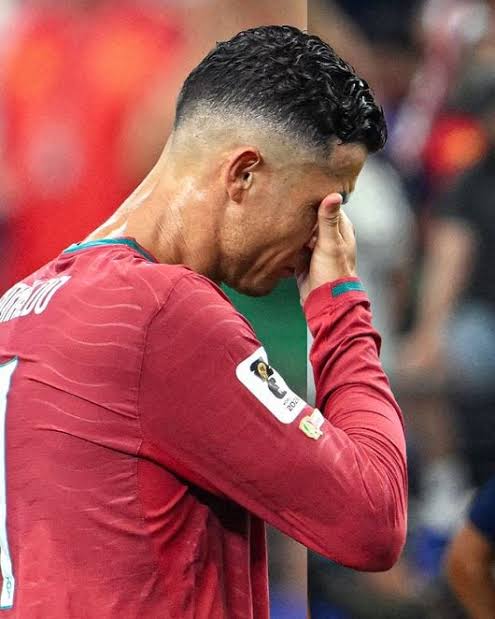
He described leaving the tournament with a clear conscience, framing the elimination as simply part of the nature of competitive sport rather than a source of lasting disappointment. “I’m leaving with clear conscience. Sometimes you win, sometimes you lose,” he said. “I’m sad now after being eliminated like this… but I gave it all, my very best. We played a good game; the performance was well done. We could have done better, but Spain are among the best; they will get to the final or close,” he said.
Ronaldo closes out his World Cup career with 27 appearances and 11 goals across six editions of the tournament, a remarkable record built over nearly two decades at the top level of international football, yet one still missing the single trophy that mattered most to him.
At this year’s tournament, he scored a brace against Uzbekistan and converted a penalty against Croatia, finishing with three goals in what he has now confirmed was his farewell World Cup campaign. His deepest run at the tournament came at his debut back in 2006, when Portugal reached the semi-finals, a high point he was never quite able to surpass in the five subsequent editions he featured in.
While the World Cup trophy ultimately eluded him, Ronaldo’s international honours board is far from empty. He lifted the European Championship with Portugal in 2016, a triumph he now places on equal footing with football’s biggest prize, and added two UEFA Nations League titles to his collection in the years that followed, cementing his status as the most decorated player in Portuguese football history regardless of the missing World Cup.
The manner of Portugal’s exit, a narrow 1-0 defeat settled by a stoppage-time strike from a substitute, will likely sting for a squad that many felt had the quality to go further in the tournament. Yet Ronaldo’s post-match comments suggest a player at peace with the outcome, one measuring his career not by the single trophy he never won, but by the collective silverware he helped deliver for a national team that had none before his arrival.
For Spain, the win sends them through to the quarter-finals, where they will face the winner of the USA-Belgium tie, continuing their own campaign as one of the tournament favourites following Ronaldo’s own assessment that they “are among the best” and could go all the way to the final.
As Ronaldo now turns his attention away from World Cup football, the emotional tenor of his final press conference, equal parts gratitude, pride, and quiet finality, offers a fitting close to a chapter that began nearly twenty years ago in Germany. Whether Portugal’s all-time great appears again for his country in future European Championship or Nations League competitions remains an open question, one he himself suggested he is not yet ready to answer, preferring instead to take time with his family before deciding what, if anything, comes next in an international career defined as much by relentless competitiveness as by the two trophies that came to define its legacy.
That legacy now closes with a World Cup ledger that reads 27 appearances and 11 goals spread across six tournaments, a run of longevity almost unmatched in the modern game. Few outfield players have managed to remain a starting-calibre presence at six separate World Cups, let alone contribute goals at nearly every stop along the way, and Ronaldo’s ability to still find the net at 41, with a brace against Uzbekistan and a converted penalty against Croatia this year alone, underlines just how remarkable his physical conditioning and competitive edge have remained deep into what would, for most players, already be considered well past their prime.
His World Cup story is, in many ways, a story of near misses rather than outright failure. Portugal’s semi-final run in 2006, Ronaldo’s debut tournament, remains the closest he ever came to reaching the final itself, a golden generation moment built around a then-young winger who had not yet fully emerged as the generational talent he would become. In the editions that followed, Portugal never quite recreated that depth of run, exiting at earlier stages even as Ronaldo himself continued to deliver goals and moments of individual brilliance on the biggest stage.
That contrast, individual excellence set against a national team that could never quite go all the way, has long framed the discourse around Ronaldo’s World Cup career, particularly when set beside the international success of his generational rival, Lionel Messi, who lifted the trophy in Qatar. Ronaldo’s own comments after Monday’s exit suggest he has made peace with that comparison, choosing instead to measure his career by the silverware he did deliver for Portugal rather than the one prize that stayed just out of reach.
That silverware is not insignificant. Portugal’s Euro 2016 triumph, achieved in France with Ronaldo captaining the side, remains one of the most celebrated moments in the country’s footballing history, made all the more dramatic by the fact that Ronaldo himself was forced off injured early in the final before watching his teammates complete the job from the touchline. The two subsequent UEFA Nations League titles further cemented Portugal’s transformation, under Ronaldo’s captaincy, from a talented but often underachieving footballing nation into a side with a genuine winning culture at senior international level.
It is against that backdrop that Ronaldo’s insistence that Euro 2016 carries the same weight as a World Cup should be understood, not simply as a consolation offered in the immediate sting of elimination, but as a considered position built on having actually delivered that continental trophy to a country that had never won a major honour before his emergence. His own framing, that Portugal went from zero titles before him to three under his watch, places the emphasis squarely on collective achievement rather than any single missing accolade.
Monday’s defeat itself was a tight, tense affair decided by fine margins. A goalless draw deep into stoppage time was broken by Mikel Merino, introduced from the bench, whose late intervention proved enough to send Spain through and end Portugal’s tournament. Ronaldo’s own assessment of the performance, that Portugal played well and could have done better in patches, but that Spain are among the tournament’s genuine contenders, reflects a measured rather than bitter response to the result, consistent with the broader tone of acceptance that ran through his post-match remarks.
For Spain, the win keeps alive their own World Cup ambitions, setting up a quarter-final meeting with the winner of the USA-Belgium tie. Ronaldo’s own prediction, that Spain will reach the final or come close, adds an intriguing subplot to the remainder of the tournament, with the very team that ended his World Cup career now being publicly backed by him as one of the sides most likely to go all the way.
As for what comes next for Ronaldo himself, his comments leave the door only partially open. He has been unambiguous that his World Cup career is finished, a sixth and final campaign now complete, but stopped short of confirming whether he intends to retire from international football altogether or continue turning out for Portugal in European Championship and Nations League competitions where the World Cup’s four-year cycle and the physical demands of a month-long tournament in unfamiliar climates are not factors.
His stated need for time with family before making that decision suggests the football world may not receive a definitive answer immediately, leaving fans and pundits alike to speculate on whether Monday’s exit was merely the end of one chapter in Ronaldo’s international story, or the beginning of the final one.
What is beyond dispute is the scale of what Ronaldo leaves behind on the World Cup stage even without the trophy he wanted most. Six consecutive editions of the tournament spanning from 2006 to this year’s competition, 27 caps at the sport’s biggest event, and 11 goals scored across two decades of shifting Portuguese squads place him among a small handful of players in the game’s history to sustain that level of presence across such a long international career.
Add to that the Euro 2016 title and the two Nations League crowns, and the picture that emerges is of a player who, by his own account and by the record books, transformed Portugal’s standing in world football regardless of the one prize that remained just beyond his grasp. For a nation that had won nothing of note on the senior international stage before his emergence, that transformation, in Ronaldo’s own telling, is more than enough reason to leave the World Cup stage with the clear conscience he described in Arlington.
Portugal’s own campaign, meanwhile, ends in Arlington with the squad now facing questions of its own about transition, roster rebuilding, and who might eventually inherit the captaincy and creative burden Ronaldo has carried for the better part of two decades. Those questions, though, belong to another news cycle. For now, the story remains Ronaldo’s own reckoning with a career that delivered nearly everything except the single trophy that eluded generations of Portuguese footballers before him, and by his own measure, that is a legacy he is content to carry forward without regret.
Author