

State Police Bill Advances as 24 State Assemblies Hold the Key to Nigeria’s Biggest Policing Reform Since 1999
Nigeria has moved significantly closer to overhauling its security architecture after the Senate approved a landmark constitutional amendment seeking to establish state police services alongside the existing federal policing structure.
The passage of the State Police Constitution Alteration Bill marks one of the most consequential legislative developments in Nigeria’s democratic history and shifts the battle for the reform from the National Assembly to the country’s 36 state Houses of Assembly.
For the proposal to become law, at least 24 state legislatures must endorse it in line with constitutional requirements for amendments. The next phase is expected to trigger intense political consultations, lobbying efforts and nationwide debate over what could become the most transformative security reform since Nigeria’s return to democratic rule in 1999.
The Senate’s approval comes against the backdrop of escalating security challenges across the federation, including terrorism, banditry, kidnapping, communal clashes, armed robbery, cybercrime and organised criminal activities.
For decades, security experts, governors, constitutional reform advocates and former political leaders have argued that Nigeria’s highly centralised policing structure has become increasingly inadequate for a country with a population exceeding 230 million people.
The latest vote therefore represents a major milestone in a long-running national conversation about how best to secure Africa’s most populous nation.
Senate Secures Constitutional Majority
The bill was approved after senators secured the constitutionally required two-thirds majority vote.
Interestingly, lawmakers were forced to abandon electronic voting due to technical glitches affecting voting devices in the Senate chamber.
To avoid disenfranchising members whose devices malfunctioned, senators adopted a manual voting process.
Leading the motion, Senate Leader Senator Opeyemi Bamidele argued that every senator deserved an opportunity to participate in what many lawmakers described as a historic constitutional exercise.
“Rather than go by way of electronic voting, which obviously now will disenfranchise a few or some of our colleagues whose machines are not working, I am moving that we allow every distinguished senator to answer his or her father’s name by doing manual voting,” Bamidele said.
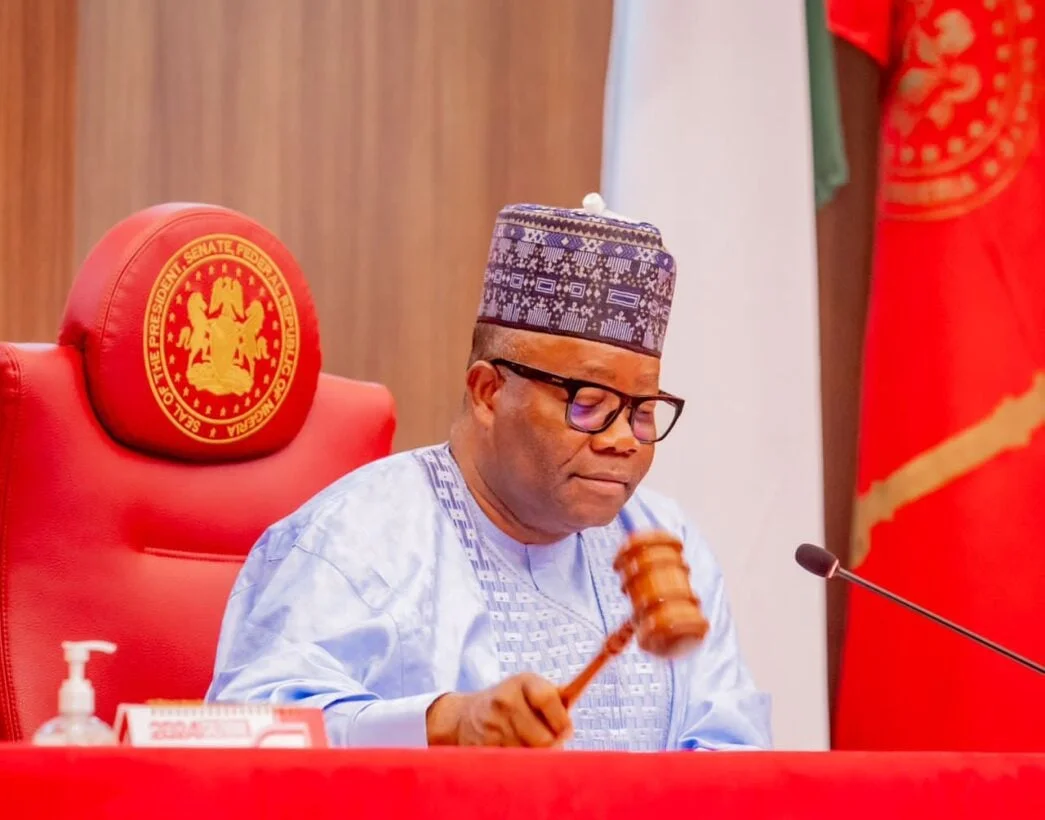
Senate President Godswill Akpabio endorsed the proposal.
“For transparency, and the need for the constituents to know where you stand on every issue, it is good for us to go into manual voting,” he stated.
Following the adoption of the motion, senators publicly declared their positions during clause-by-clause consideration of the constitutional amendment.
The bill was eventually passed after lawmakers adopted the report of the Senate Committee on the Review of the Constitution, chaired by Deputy Senate President Barau Jibrin.
What the State Police Bill Proposes
At the heart of the constitutional amendment is the creation of a dual policing structure.
Under the proposed arrangement, the existing Nigeria Police Force would continue to function as the country’s federal police service, while states would be empowered to establish and operate their own police formations.
The amendment proposes that each state police service would be headed by a Commissioner of Police appointed by the governor and confirmed by the state’s House of Assembly.
Clause 17 of the proposed amendment states:
“While the Federal Police Service will continue to be headed by the Inspector-General of Police, each State Police Service shall be headed by a Commissioner of Police appointed by the governor and confirmed by the legislature of the state.”
This provision represents a significant shift from Nigeria’s current policing model, where all police officers operate under federal command.
Division of Responsibilities
One of the central features of the proposal is the clear separation of duties between federal and state police authorities.
According to Bamidele, state police services would be responsible for enforcing state laws, maintaining public safety, preserving public order, preventing and detecting crimes within their jurisdictions and protecting lives and property.
They would also undertake community-based policing and local intelligence gathering.
The federal police, on the other hand, would retain responsibility for matters of national security.
These include:
- Counter-terrorism operations
- Border security
- Organised crime investigations
- Cybercrime enforcement
- Arms trafficking
- Interstate criminal activities
- Protection of federal institutions
Supporters argue that this division of responsibilities would allow law enforcement agencies to become more specialised and effective.
Safeguards Against Abuse
One of the biggest concerns surrounding state police has historically been the fear that governors could use security agencies as political weapons against opponents.
This concern has stalled previous attempts to introduce state policing.
To address these fears, lawmakers included several constitutional safeguards.
One key provision states:
“A state Commissioner of Police shall not arrest, detain, investigate or deploy force against any person, political party or group merely for criticising the government except in accordance with the law.”
The amendment also empowers the National Assembly to prescribe minimum standards for recruitment, training, discipline, promotion, accountability mechanisms, use of force, firearms regulations and professional conduct.
Bamidele said the framework was deliberately designed to strike a balance between local autonomy and national oversight.
“The bill provides robust safeguards against abuse, preserves federal authority where necessary, protects constitutional rights and creates a modern policing framework capable of addressing contemporary security challenges,” he said.
When Federal Authorities Can Intervene
The proposed legislation also outlines circumstances under which federal police authorities may intervene in state security matters.
According to the Senate Leader, intervention may occur when:
- There is a complete breakdown of public order
- State police become incapable of functioning
- Fundamental rights are being seriously violated
- Electoral intimidation is established
- National security is threatened
Even in such cases, intervention would require written authorisation from the President and remain subject to Senate oversight and judicial review.
These measures are intended to prevent conflicts between federal and state security authorities.
Governors and Top Officials Observe Proceedings
The significance of the Senate vote was reflected in the calibre of political figures present during proceedings.
Among those who observed the constitutional amendment exercise from the gallery were:
- Uba Sani
- Dapo Abiodun
- Lucky Aiyedatiwa
- Femi Gbajabiamila
Their presence underscored the enormous political implications of the proposed reform.
Security Experts and Stakeholders Back Reform
Support for state policing continues to grow among security experts and regional security organisations.
Retired Assistant Inspector-General of Police Aare Tunji Alapinni described the proposal as an opportunity to strengthen grassroots security and revive community intelligence systems.
According to him, Nigeria’s current security realities demand new approaches.
“The security situation in the country calls for doing the same thing in a different manner,” he said.
Alapinni argued that local policing structures would improve intelligence gathering because community members are often better positioned to identify suspicious activities.
He recalled how communities previously monitored unfamiliar individuals entering their areas and suggested that community-based policing could restore such vigilance.
Amotekun Cites Regional Success
The Western Nigeria Security Network, popularly known as Amotekun, also expressed strong support for the proposal.
Western Nigeria Security Network officials argued that their operational successes demonstrate the effectiveness of decentralised security structures.
The Chairman of Amotekun Commanders in the South-West, Adetunji Adeleye, described state policing as the most viable solution to Nigeria’s security challenges.
He noted that Amotekun had successfully arrested and prosecuted hundreds of suspects in recent years.
“State policing remains the only viable solution to the present insecurity in the country,” he said.
He also confirmed that the South-West region is prepared to align with any framework adopted for state policing.
Economic and Operational Benefits
Supporters argue that state police would significantly increase Nigeria’s policing capacity.
The Director-General of the Development Agenda for Western Nigeria (DAWN) Commission, Seye Oyeleye, estimated that if each state recruited approximately 5,000 officers, Nigeria would gain about 180,000 additional police personnel.
He described the Senate’s approval as a milestone in the country’s journey towards true federalism.
“We are a country of over 230 million people with different ethnic groups. One-size-fits-all policing is no longer adequate,” Oyeleye said.
He also noted that governors currently provide vehicles, logistics and equipment to police commands but lack operational control over security personnel.
Attention Turns to State Assemblies
Despite the Senate’s approval, the bill faces its most important hurdle yet.
Under the Constitution, constitutional amendments require approval by at least two-thirds of state legislatures.
This means no fewer than 24 state Houses of Assembly must endorse the proposal before it can be transmitted to President Bola Tinubu for assent.
The coming weeks are expected to witness extensive consultations among governors, lawmakers, civil society groups, security experts and political stakeholders.
If the required approvals are secured, Nigeria would be on the verge of implementing one of the most significant security reforms in its modern history.
For supporters, state police offer a long-awaited solution to worsening insecurity.
For critics, the focus remains ensuring that constitutional safeguards are strong enough to prevent political abuse.
Either way, the future of state policing now rests with state assemblies across the federation, where the next chapter of this historic reform will be written.
Author