
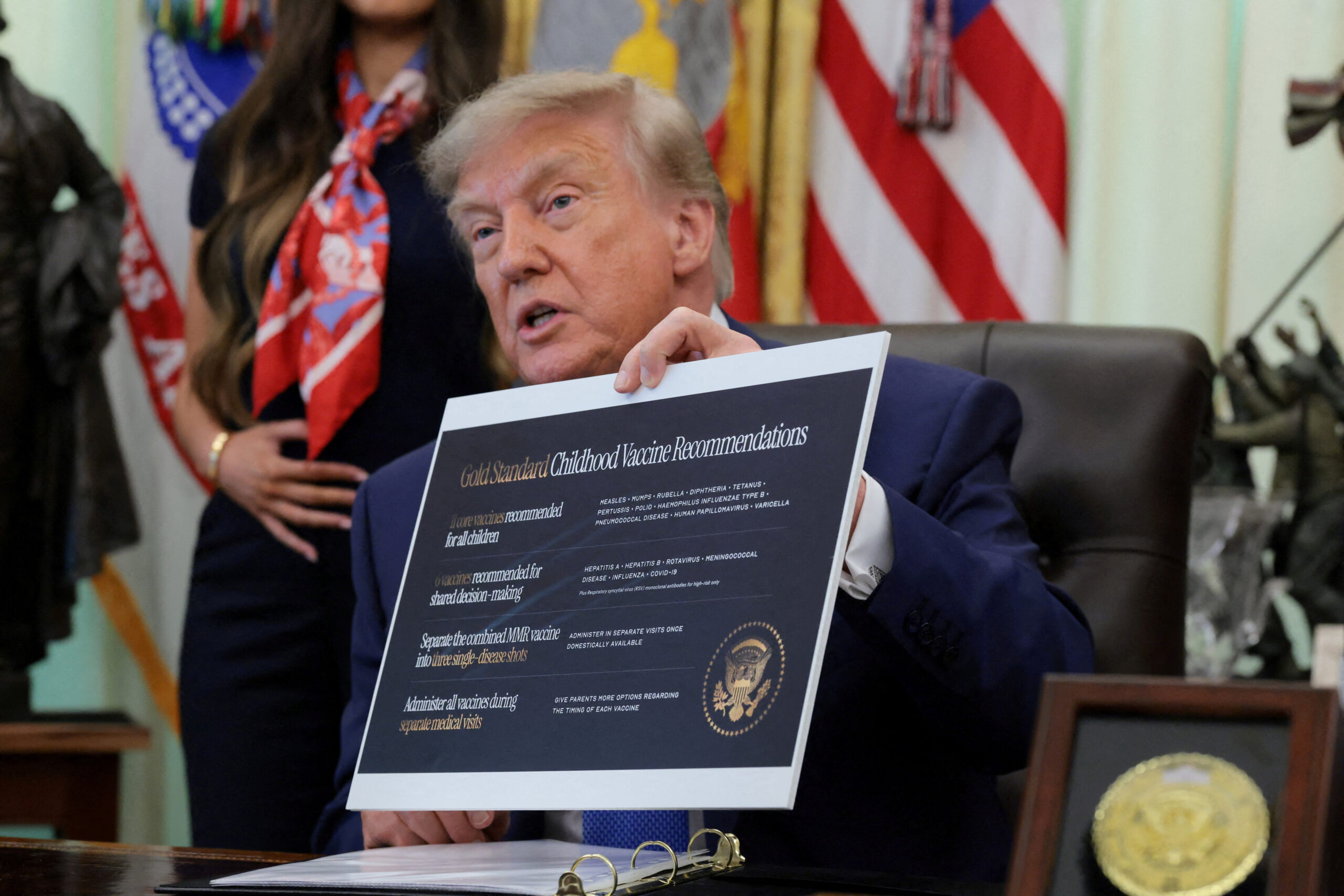
US President Donald Trump has signed an executive order calling for changes to childhood vaccine policy, including a review of school vaccination requirements and renewed efforts to make measles, mumps and rubella vaccines available as separate shots.
Trump signed the order on Monday as children across the United States prepare to return to school and the country faces its worst measles outbreak in 35 years.
The order directs the US Department of Health and Human Services to establish a task force that will work with private-sector partners and other countries to make individual MMR vaccines available, while maintaining access to the combined vaccine and other vaccines recommended through shared clinical decision-making.
The administration is also urging states and territories to review federal recommendations on vaccination requirements for school enrolment and attendance.
However, the federal government does not have direct authority over several of the areas covered by the order. States generally determine whether students must be vaccinated to attend school.
The order therefore serves partly as guidance rather than a direct federal mandate.
The push to separate the MMR vaccine has been a longstanding priority of Health Secretary Robert F. Kennedy Jr., who has promoted claims linking vaccines to autism despite extensive scientific evidence rejecting such a connection.
Public health experts have continued to support the combined MMR vaccine, citing decades of safety data and its ability to provide protection against three diseases through a single vaccination.
Experts also warn that separating the vaccines could create additional logistical challenges for parents and delay protection for children.
During the signing ceremony in the Oval Office, Trump made unsupported claims about the safety of combined vaccines.
Andrew Racine, president of the American Academy of Pediatrics, told reporters that developing and approving separate vaccines in the United States could take more than a decade.
“We’re advising that you continue to give children a vaccine that has decades of safety data,” said Aaron M. Milstone, a member of the AAP Committee on Infectious Diseases.
Measles Outbreak Raises Concerns
The administration’s latest move comes after a federal court earlier this year blocked major changes to US vaccine policy while litigation continues.
The ruling followed legal challenges from major medical organisations, which argued that the administration’s actions were unlawful.
The timing of Trump’s new order has also drawn attention because of the ongoing measles outbreak, the most severe US outbreak in 35 years.
Kennedy has faced criticism from public health experts who accuse him of promoting vaccine-sceptic views and contributing to public concerns about established immunisations.
Most Americans continue to support vaccination, according to polling, although the issue remains politically contentious ahead of the November midterm elections.
Trump and Kennedy have both previously faced criticism over claims linking vaccines to autism. That proposed connection has been rejected by extensive scientific research.
Jeffrey Singer of the Cato Institute said the administration’s proposed changes highlighted the risks of allowing government recommendations to play an overly influential role in individual medical decisions.
Author