
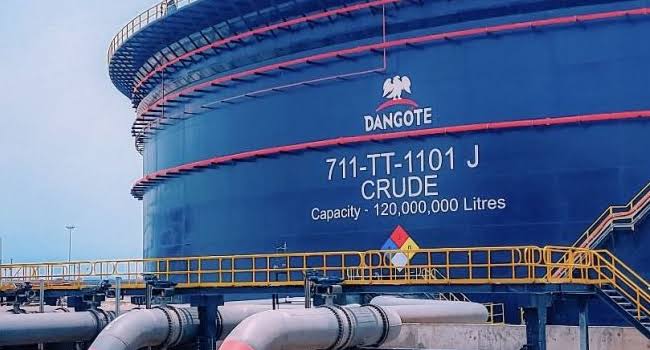
The Dangote Refinery accounted for about 98 per cent of the crude oil and condensate offered to Nigeria’s domestic refineries in the second quarter of 2026, according to data from the Nigerian Upstream Petroleum Regulatory Commission.
The figures indicate increased implementation of the Domestic Crude Supply Obligation, a framework being enforced by the NUPRC under Section 109 of the Petroleum Industry Act.
Under the obligation, oil producers are required to make crude available to licensed domestic refineries to support local refining and reduce Nigeria’s dependence on imported petroleum products.
According to data released by the Commission on Monday, domestic refiners were offered a combined 69.3 million barrels of crude oil and condensate between April and June.
Of that volume, 68.1 million barrels were offered to the Dangote Refinery, which had indicated a requirement of 63 million barrels for the quarter.
Despite receiving the overwhelming share of the offers, the refinery took delivery of 52.6 million barrels, representing about 77 per cent of the volume offered to it.
The quantity received by the Dangote Refinery was also about 10.4 million barrels below its stated requirement.
Overall, local refiners received 53.7 million barrels during the quarter, meaning the Dangote Refinery accounted for approximately 98 per cent of actual domestic crude supplies.
The NUPRC said producers had been allocated 55.1 million barrels between April and June but offered 69.3 million barrels, exceeding their allocation by 14.2 million barrels, or 25.8 per cent.
Actual deliveries, however, stood at 53.7 million barrels, leaving about 15.6 million barrels of the crude offered unutilised. The volume supplied was also approximately 1.4 million barrels below the total allocation.
The Commission explained that the DCSO is administered through monthly consultations involving crude producers and licensed domestic refineries. Producers are subsequently allocated specific volumes of crude and condensate to offer to local refiners.
However, the eventual transactions are governed by the Petroleum Industry Act’s “willing buyer, willing seller” principle. This means the quantity offered by producers does not necessarily translate into the same volume purchased and received by refiners.
Performance varied across the three months.
In April, producers were allocated 18.13 million barrels and offered 19.31 million barrels, while actual supplies reached 20.88 million barrels, representing 114.9 per cent performance against the monthly allocation.
In May, producers were allocated 18.78 million barrels and offered 23.19 million barrels, but actual supplies fell to 14.23 million barrels, representing 75.8 per cent compliance and leaving a shortfall of about 4.55 million barrels against the allocation.
Performance improved in June, when producers were allocated 18.17 million barrels and offered 26.84 million barrels. Actual supplies reached 18.61 million barrels, representing 102.4 per cent performance.
The monthly figures showed that producers consistently offered volumes above their allocations, although actual deliveries were determined partly by the quantities refiners were willing or able to purchase under the commercial arrangements.
The NUPRC attributed the improved DCSO performance to rising domestic oil production and the signing of long-term crude supply agreements backed by bankable Sales and Purchase Agreements between producers and local refiners.
The Commission said the second-quarter results demonstrated that the DCSO was “actively administered and enforced” and reaffirmed its commitment to sustaining the progress.
It said it would continue using the Petroleum Industry Act framework to support higher crude production and enforce the domestic supply obligation as part of efforts to achieve Nigeria’s energy sufficiency goals.
The development comes as Nigeria seeks to strengthen domestic refining capacity, secure adequate crude feedstock for local refineries and reduce reliance on imported petroleum products.
Author