
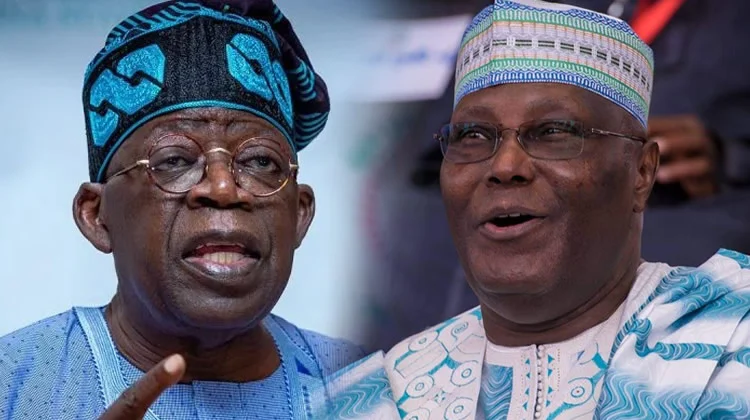
President Bola Ahmed Tinubu has defended his administration’s economic reforms as necessary measures to put Nigeria on course for a $1tn economy by 2030, while former Vice President Atiku Abubakar has criticised the policies, questioning why Nigerians had to endure years of hardship before the government began promising relief.
The contrasting positions emerged on Tuesday as the administration highlighted improvements in foreign reserves, revenue mobilisation, trade and economic growth, while Atiku’s camp argued that the gains being presented by the government had yet to translate into meaningful relief for households.
Tinubu, represented by the National Chairman of the All Progressives Congress, Prof Nentawe Yilwatda, at the second edition of the Asiwaju Scorecard Series and Policy Roundtable in Abuja, said the reforms had strengthened the foundation for economic stability and long-term growth.
The President said his administration inherited an economy affected by fuel subsidy distortions, multiple foreign exchange windows, weak revenue mobilisation, foreign exchange shortages, rising debt-service pressures and inadequate investment in critical infrastructure.
“When President Bola Ahmed Tinubu assumed office on 29 May 2023, Nigeria faced a difficult economic inheritance. We had fuel subsidy distortions, multiple exchange-rate windows, weak revenue mobilisation, foreign-exchange shortages, rising debt-service pressures and years of inadequate investment in critical infrastructure.
“The President understood that Nigeria could not continue on that trajectory and therefore took difficult decisions, including the removal of the fuel subsidy and the reform of the foreign-exchange market,” Yilwatda said on Tinubu’s behalf.
According to the President, the impact of the reforms is increasingly reflected in key economic indicators.
“The evidence increasingly shows that the foundation is strengthening. Nigeria’s gross external reserves have risen to about $52.7bn by August 2026.
“Consolidated non-oil revenue increased from approximately N13.63tn in 2023 to N16.4tn in the first two quarters of 2026, demonstrating the growing contribution of non-oil sources to government revenue.
“Our trade position has also improved dramatically: from a merchandise trade surplus of only about N44.8bn for the whole of 2023 to approximately N7.54tn in the first quarter of 2026 alone.
“Real GDP grew by 4.43 per cent in Q2 2026, while inflation has fallen significantly from its earlier peak to about 15.4 per cent.”
Yilwatda, speaking on Tinubu’s behalf, acknowledged that the figures did not mean Nigeria’s economic difficulties had disappeared but argued that they showed a change in direction.
“These figures do not mean that our economic challenges have disappeared, but they demonstrate that the direction of travel has changed.
“And let me emphasise: macroeconomic stability is not the destination; it is the foundation. The ultimate test is when stability translates into cheaper food, more jobs, affordable credit, reliable electricity and greater purchasing power for Nigerians,” he said.
Tinubu outlines $1tn economy strategy
Tinubu said the administration’s ambition to build a $1tn economy by 2030 goes beyond achieving a headline economic figure, describing it as a broader national development objective.
“It is not merely a number, but a national mission: a Nigeria that produces more, exports more, attracts more investment, creates more jobs and gives its young people a greater stake in the future,” he said.
He identified infrastructure as central to achieving the target, saying the Renewed Hope Agenda prioritises roads, railways, ports, energy and digital connectivity.
Tinubu also proposed an integrated five-port maritime and logistics corridor linking major deep-sea ports in Lagos, Ondo, Ibom, Port Harcourt and Calabar through modern road and rail infrastructure.
“Nigeria must now take full advantage of its enormous maritime opportunity by developing an integrated five-port maritime and logistics corridor,” he said.
He said the Lagos-Calabar Coastal Super Highway would serve as the principal coastal road spine, while the Western Corridor would connect maritime gateways to the interior through the Lagos–Abuja–Kaduna–Kano rail corridor and the Sokoto–Badagry Super Highway.
The Eastern Corridor, he said, would connect eastern maritime gateways through the Port Harcourt–Abuja–Kaduna–Kano rail corridor and the proposed Calabar–Maiduguri Trans-Sahara Super Highway.
“In this way, Nigeria can create an integrated national transport system in which our five deep-sea ports are connected, connected to our major cities and production centres, and connected ultimately to the landlocked markets of Niger, Chad, Burkina Faso, Sudan and the Central African Republic,” Tinubu said.
He argued that the proposed infrastructure network could position Nigeria as a major logistics and maritime hub for West and Central Africa.
“This is how Nigeria can move beyond being simply a coastal trading nation to becoming the maritime gateway and logistics hub of West and Central Africa, capturing a much larger share of the continent’s trade, logistics, manufacturing and distribution value chain.
“That is more than transportation infrastructure, but a trade architecture. It would generate opportunities in logistics, warehousing, freight forwarding, customs, banking, insurance, manufacturing, distribution and agro-processing. It would create jobs, generate foreign exchange and strengthen Nigeria’s position as a regional commercial hub.”
The President said industrial parks, export-processing zones, logistics hubs, agro-processing clusters and manufacturing centres should be developed along major transport corridors.
He added that connecting rail infrastructure to agricultural and mineral-producing areas would encourage processing and manufacturing, while Nigeria’s maritime strategy should extend beyond individual ports to shipping, logistics, ship repair, marine services, finance, fisheries, offshore energy, tourism and marine technology.
“Every container through a Nigerian port is an economic opportunity. Every Nigerian agricultural product exported is an opportunity. Every factory established along a transport corridor is an opportunity. Every international company that chooses Nigeria as its African distribution base is an opportunity. That is how we grow GDP, create jobs, earn foreign exchange and build the foundation of a $1tn economy,” he said.
Tinubu also identified Nigeria’s gas resources and the Ajaokuta-Kaduna-Kano gas pipeline as strategically important to connecting gas supplies with population and industrial centres in Northern Nigeria.
“It is about electricity, fertiliser, manufacturing, transportation, energising homes and industrialisation,” he said.
Government highlights youth investment
The President also defended the administration’s investments in young Nigerians, pointing to the Nigeria Education Loan Fund, technical and vocational education initiatives, digital skills programmes and the Consumer Credit Corporation.
“We are investing in the future of our young people because they are the greatest asset of the Nigerian economy.
“Through NELFUND, we are expanding access to higher education so that financial circumstances do not prevent young Nigerians from acquiring the knowledge they need to succeed,” Tinubu said.
He said the government was also supporting technical and vocational education through grants and skills-development opportunities, while digital training programmes were intended to prepare young Nigerians for the global digital economy.
On access to credit, he said initiatives such as CREDICORP were designed to enable workers, entrepreneurs and businesses to acquire productive assets, expand enterprises and create jobs.
“This is not simply social investment; it is an investment in the productive capacity of Nigeria and in the young Nigerians who will ultimately build and drive our $1 trillion economy,” he said.
APC defends subsidy removal
Earlier at the event, the Chairman of the APC Professionals Forum’s Board of Trustees, Dr Isa Yuguda, said the 2027 presidential election should be judged on achievements, policies and realistic solutions.
Yuguda described the removal of the fuel subsidy as difficult but necessary, citing his experience as chairman of the 2009 Fuel Subsidy Task Force, where he said he encountered widespread fraud and financial leakages.
He said the reform had reportedly saved more than N15tn, creating additional resources for education, security, agriculture and infrastructure.
Yuguda warned that returning to the subsidy regime could undermine those gains.
“As we approach the 2027 election, Nigerians must carefully evaluate political promises, particularly those relating to the return of fuel subsidy.
“The proposal by former Vice President Alhaji Atiku Abubakar to restore subsidy may appear attractive to citizens seeking immediate relief, but it must be examined against our national experience.
“The old subsidy regime was associated with massive leakages, fraudulent claims, inefficiency, and a significant drain on public finances.
“Presenting a return to that system without clearly addressing these problems risks misleading Nigerians for short-term political gain and could reverse the fiscal space now supporting critical national investments,” he added.
Atiku challenges Tinubu over economic hardship
Atiku, the presidential candidate of the African Democratic Congress, has continued to oppose key policies of the Tinubu administration as the 2027 general elections approach, particularly its economic reforms and their effect on the cost of living.
Responding to Tinubu’s recent criticism of proposals aimed at reducing energy costs, Atiku accused the administration of allowing Nigerians to endure years of economic hardship before promising relief.
In a statement issued by his Senior Special Assistant on Public Communication, Phrank Shaibu, titled “Tinubu, the issue is not Atiku — it is why Nigerians can no longer afford to live,” the former vice president said the dispute was not a personal contest between him and the President.
Shaibu said Atiku would continue to advocate policies aimed at lowering the cost of living.
“Atiku has more important people to engage directly: the mother struggling to feed her children; the civil servant whose salary disappears into transportation; the farmer paying more to move produce to market; the student being pushed into debt simply to remain in school; and millions of Nigerians whose daily reality bears no resemblance to the prosperity advertised in your tweets.”
The statement followed Tinubu’s criticism of Atiku’s proposals to reduce energy costs and his rejection of any return to the era of fuel subsidy.
Atiku’s camp questioned why the administration was now promising cheaper transportation, increased food production and support for vulnerable Nigerians after more than three years of economic hardship.
“Why did Nigerians have to suffer for more than three years before your government discovered that economic growth must reach ‘the dining table and the pocket’?
“Why is intervention backwards when Atiku proposes it, but progressive when you announce it?” Shaibu asked.
Atiku proposes cheaper energy
Atiku’s camp argued that reducing energy costs would have a wider effect across the economy by lowering transportation and production expenses and, ultimately, the cost of food and other essential goods.
The Atiku Economic Recovery Plan, according to the statement, would provide targeted support for Nigerian crude supplied for domestic refining under a capped and transparently budgeted framework.
The proposal would also involve tracking crude supplied, monitoring refined petroleum products and introducing a consumer pass-through mechanism to ensure that the benefits reach consumers.
“The economics is straightforward. Reduce fuel costs, and you reduce pressure on transportation. Reduce transportation costs, and you reduce the cost of moving tomatoes, rice, yam, livestock and manufactured goods,” Atiku said.
He said the objective was to deliver “structural relief” instead of allowing living costs to continue rising before introducing temporary palliatives.
Student loans become another point of dispute
Atiku’s camp also criticised the government’s student loan programme, arguing that the administration had increased the cost of education before presenting loans as a solution.
Atiku described arguments that cheaper fuel would threaten NELFUND, workers’ salaries or the minimum wage as “fearmongering dressed up as economics.”
“Celebrating NELFUND as proof that education has become affordable under your government is like setting school fees on fire and then boasting that you lent students a bucket of water,” he said.
The former vice president said he had reviewed the student loan policy and would seek to reduce the underlying cost of education while considering forgiveness for qualifying student debts.
“A student loan is not a scholarship. It is a liability,” Atiku said, arguing that education policy should allow young Nigerians to obtain an education without being pushed into unsustainable debt.
Subsidy savings and government finances questioned
Atiku also demanded explanations over the financial benefits of the petrol subsidy removal.
According to him, the Federal Government had stated that subsidy removal mobilised about N15.8tn between June 2023 and December 2025. He questioned what measurable benefits ordinary Nigerians had received in exchange for the economic sacrifice.
“Atiku wants to offer Nigerians more than empty figures. He has a plan that respects the dignity and protects the survival of the Nigerian people,” he said.
The statement also renewed demands for reconciliation of figures involving about N30tn in Federation Account revenues, deductions, savings, transfers and related entries.
It questioned Import Duty Exemption Certificate approvals covering about N34tn worth of imports in 2025 and called for disclosure of the beneficiaries, values, legal basis and public benefits associated with the exemptions.
“So when you suddenly announce that relief is coming ‘in the next few weeks,’ Nigerians are entitled to ask: Why now?” the statement added.
Atiku’s camp further alleged that the promised relief could become “a temporary dose of political anaesthesia as 2027 approaches,” while arguing that Nigerians should distinguish between election-season measures and sustainable economic recovery.
The exchange between the President and the ADC presidential candidate comes as political parties and opposition figures intensify preparations for the 2027 general elections, with economic hardship, fuel prices, food inflation, wages and social protection increasingly emerging as central issues in the political contest.
Author