
Peter Obi Tinubu Resignation Debate Deepens Political Tensions Ahead of 2027
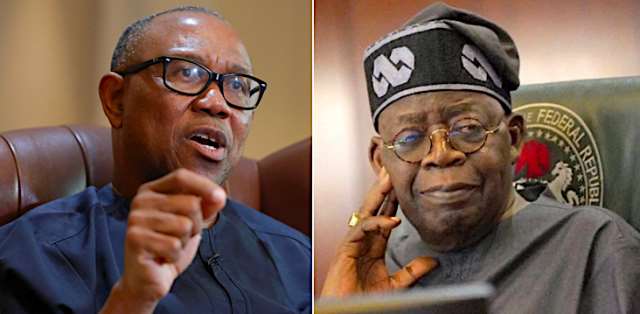
A fresh political confrontation has erupted between the Presidency and former Labour Party presidential candidate Peter Obi after the opposition figure called on President Bola Tinubu to resign over what he described as a “monumental failure in governance.”
The exchange has intensified political tensions ahead of the 2027 general elections, with both sides trading accusations over accountability, leadership performance and the state of the nation.
Obi’s comments, which were inspired by a recent resignation announcement by the British Prime Minister, have reopened debates about governance standards, democratic accountability and the direction of Nigeria under the current administration.
The Presidency, however, has strongly rejected the demand, describing it as “childish,” “misplaced” and politically motivated.
The latest verbal battle underscores the growing rivalry between the two camps as political realignments continue to gather momentum ahead of the next presidential election.
Obi Calls for Accountability in Leadership
In a statement issued on Monday, Peter Obi said his position was informed by the culture of accountability practiced in mature democracies.
According to him, leaders should accept responsibility when governments fail to meet public expectations and campaign promises.
He said he was prompted to reflect on the issue after listening to a speech by the British Prime Minister announcing plans to step down amid public dissatisfaction over economic challenges and unmet commitments.
Obi argued that strong democracies are built on a foundation where leaders are held accountable for their actions and where poor performance carries consequences.
He maintained that Nigeria must begin to institutionalise a similar culture.
“Successful democracies are sustained by a culture of responsibility, where leaders accept the consequences of policy failures and declining public confidence,” he said.
Obi Draws Comparison With Tinubu’s Past Criticism of Jonathan
The former Anambra State governor also referenced President Tinubu’s criticisms of former President Goodluck Jonathan before the 2015 elections.
Obi recalled that Tinubu had repeatedly called for Jonathan’s resignation over insecurity and economic challenges.
He specifically mentioned Tinubu’s reaction during the abduction of the Chibok schoolgirls, noting that the then-opposition leader had accused the government of failing in its constitutional responsibility to protect citizens.
According to Obi, the same standard should now be applied to the current administration.
He argued that accountability should not be selective or dependent on political affiliation.
Tinubu’s Campaign Promises Under Scrutiny
Obi further pointed to several promises President Tinubu made during the 2023 presidential campaign.
These included commitments to improve electricity supply, strengthen national security, combat corruption and improve citizens’ welfare.
He also noted that Tinubu had publicly challenged Nigerians not to support him for a second term if he failed to fulfil those promises.
Obi argued that many of those commitments remain unmet.
“Electricity supply remains unreliable, insecurity has intensified in many parts of the country, kidnappings continue unabated and economic hardship has deepened,” he stated.
He added that sectors such as transportation, infrastructure development and anti-corruption efforts have also experienced setbacks.
According to him, Nigeria is facing one of its most difficult periods in recent history.
The opposition figure maintained that public office should come with consequences for poor performance.
“I join Nigerians of goodwill in calling for the resignation of the President over monumental failure in governance,” Obi said.
He further argued that such an action would help establish a culture of responsibility and discourage impunity among future leaders.
According to him, it would send a strong message that leadership is a sacred trust rather than a privilege without accountability.
Presidency Fires Back
The Presidency swiftly responded to Obi’s comments, dismissing the comparison with the British Prime Minister as inaccurate and politically opportunistic.
In a statement issued by presidential spokesman Bayo Onanuga, the government accused Obi of presenting a distorted view of Nigeria’s realities since President Tinubu assumed office in 2023.
The Presidency argued that Obi’s analysis ignored the constitutional differences between Nigeria and the United Kingdom.
“Obi’s latest comments calling for President Bola Tinubu’s resignation, based on a comparison with the British Prime Minister’s voluntary exit, are not only misplaced but also reflect a selective and distorted view of Nigeria’s realities since 2023,” the statement said.
It added:
“His view is also simplistic, as is often the case anytime he opens his mouth. Obi forgets our country does not run a parliamentary system of government like the UK. We run a presidential system, with the president elected to a fixed four-year term.”
The Presidency insisted that leadership transitions in Nigeria must occur through constitutional electoral processes rather than public pressure campaigns.
Presidency Highlights Recent Electoral Victories
The government also pointed to recent electoral victories recorded by the ruling All Progressives Congress (APC) as evidence of continued public support for President Tinubu.
According to the Presidency, the results from recent elections in Ekiti State and senatorial contests in Nasarawa, Enugu, Ondo and Rivers states indicate growing confidence in the administration.
“The people of Ekiti State and the senatorial constituents in Nasarawa, Enugu, Ondo and Rivers have just delivered a resounding victory for President Tinubu and his party,” the statement said.
It added that the outcomes could be interpreted as an early referendum on the administration’s performance.
The Presidency also directed criticism at Obi’s newly formed National Democratic Coalition (NDC), suggesting the opposition movement should focus on preparing for the 2027 elections instead.
“This should be more concerning for Peter Obi and his new Special Purpose Vehicle, NDC, as we move towards the January 2027 election,” the statement said.
The government further argued that Obi should allow Nigerians to decide the President’s fate through the ballot box.
“Obi should wait until the presidential election to know what the people think of Tinubu’s government. Moving to use X to harangue the President out of office is off the mark and anti-democratic.”
Tinubu Inherited Significant Challenges, Presidency Says
Defending the administration’s performance, the Presidency argued that President Tinubu inherited a nation already facing severe economic and security difficulties.
Officials maintained that many of the current challenges predated the administration and required long-term structural reforms.
“It is important to note that President Tinubu did not inherit a country in perfect shape,” the statement said.
Since taking office, Tinubu’s administration has implemented several economic reforms, including the removal of fuel subsidies and the unification of foreign exchange windows.
While the government argues these measures are necessary for long-term stability, critics say they have contributed to rising inflation and increased hardship for millions of Nigerians.
Political Battle Ahead of 2027 Intensifies
The latest exchange is widely seen as an early indication of the political battles expected ahead of the 2027 general elections.
Both camps are increasingly positioning themselves to shape public perception regarding governance, economic performance and national development.
For Obi, accountability remains a central campaign message.
For the Presidency, defending the administration’s record and highlighting constitutional processes will likely remain a key strategy.
As Nigeria approaches another election cycle, debates over leadership performance, democratic accountability and economic reforms are expected to dominate national discourse.
The latest clash between Peter Obi and the Presidency may therefore be only the beginning of a much larger political contest that could define the country’s future direction.
Author