
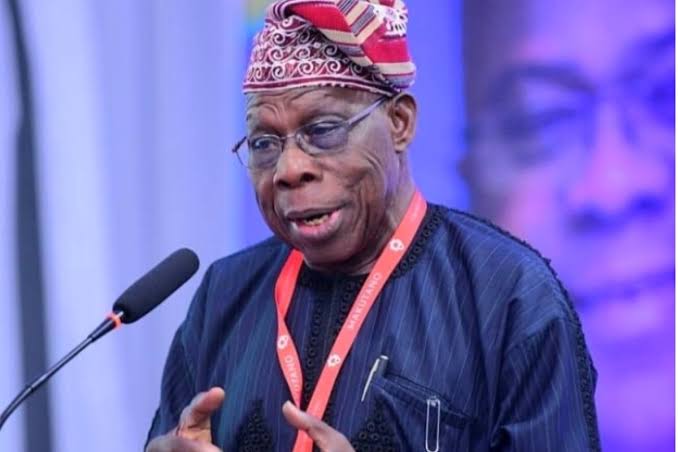
Former President Olusegun Obasanjo has backed calls for an increase in the 13 per cent derivation allocation to oil-producing states, describing the existing share as a starting point for further negotiations.
Obasanjo spoke on Monday at the flag-off of the crude distillation unit of the $1bn Azikel Refinery in Obunagha, Yenagoa Local Government Area of Bayelsa State. He also challenged the refinery’s promoter to complete the facility within 12 months.
Addressing Bayelsa State Governor Douye Diri, the former president said oil-producing states and communities had yet to receive a fair share of the benefits from resources extracted from their territories.
“You are right that the states and oil-producing communities have not got a fair deal so far. Thirteen per cent is the beginning. You can continue to talk,” he said.
His remarks came as Diri renewed calls for a review of the derivation formula and criticised the Land Use Act, arguing that communities in the Niger Delta remained excluded from decisions over the resources extracted from their land.
Obasanjo Gives Azikel Refinery 12-Month Challenge
The Azikel Refinery, owned by Azikel Petroleum under the Azikel Group, is designed to process 25,000 barrels of crude oil daily.
Obasanjo laid the foundation for the project about eight years ago, while the installation of the crude distillation unit marks a major milestone in its development.
He commended Azikel Group President Azibapu Eruani for sustaining the project and urged him to complete the facility within the next year.
“I have told Dr Eruani that I will be officially 90 years by next March. It means I will take the boarding pass soon. So, he has to make sure the project is completed before I exit,” he said.
Obasanjo also acknowledged the support of the African Finance Corporation and the African Export-Import Bank, calling for continued assistance to ensure the refinery’s completion.
“My challenge to you, Dr Eruani, is to ensure that the refinery is completed within the next 12 months. With this done, you can even double the capacity,” he said.
The former president also praised Diri for what he described as the effective use of Bayelsa’s revenue, pointing to projects across the state as evidence that available funds had been put to productive use.
“The most important thing is that even the little you have received, you have used it well,” he said.
Diri Demands Greater Resource Control
Speaking at the event, Diri said the refinery offered Bayelsa residents and the wider Niger Delta an opportunity to participate more directly in an industry built on resources extracted from their communities.
He argued that the region’s longstanding agitation over resource control stemmed from what residents viewed as an imbalance between where crude oil was produced and where the benefits accrued.
“As people of the Ijaw ethnic nationality, we have protested and fought because we feel that God gave us something in our land but we are not benefiting from it. Others are benefiting and see us as second-class citizens,” the governor said.
Diri also criticised the Land Use Act, arguing that the distinction between state control of surface resources and Federal Government control of resources beneath the ground disadvantaged oil-producing communities.
“The Land Use Act is unfair. Surface resources belong to states but what lies underneath belongs to the Federal Government. That law is obnoxious and not good for any just society,” he said.
The governor maintained that the region was not seeking to appropriate all the proceeds from its natural resources but wanted a greater role in determining how they were managed.
“We do not want to take all to ourselves. We just want to be co-players in determining how it is done. Thirteen per cent is not enough for the states,” he said.
Governor Urges Youths to Prepare for Industrial Jobs
Diri urged young people in Bayelsa to acquire the skills needed to benefit from the refinery and other industrial investments in the state.
He warned that the presence of major industrial facilities would have limited benefits for local communities if residents lacked the technical capacity to participate in their operations.
The governor also called on oil companies operating around Gbarain and Obunagha to rehabilitate the road leading to the refinery, urging them to complement the state government’s efforts to support the project.
He further stressed the need for African countries to process their natural resources locally, arguing that retaining more industrial and processing activities on the continent was essential to securing greater economic benefits.
Azikel Says Refinery Will Drive Regional Industrialisation
Eruani said the refinery was conceived to make Bayelsa and the wider Niger Delta active participants in the petroleum industry rather than remain primarily suppliers of crude oil.
He described the installation of the crude distillation unit as the beginning of the refinery’s completion phase and said the project would help drive industrialisation across the state and the region.
According to the project’s promoters, the facility is expected to produce 2.5 million litres of petrol and two million litres of diesel daily, alongside other petroleum products.
Eruani also commended President Bola Tinubu for supporting indigenous refineries, saying their development aligned with the Federal Government’s objective of improving the availability and affordability of petroleum products.
Azikel Petroleum board member Daru Owei and the Ibenanaowei of Ekpetiama Kingdom and Chairman of the Bayelsa State Council of Traditional Rulers, King Bubaraye Dakolo, also praised Eruani for the project.
They said the refinery could improve the economic fortunes of Bayelsa, the Niger Delta and Nigeria.
Follow us on:
Author