

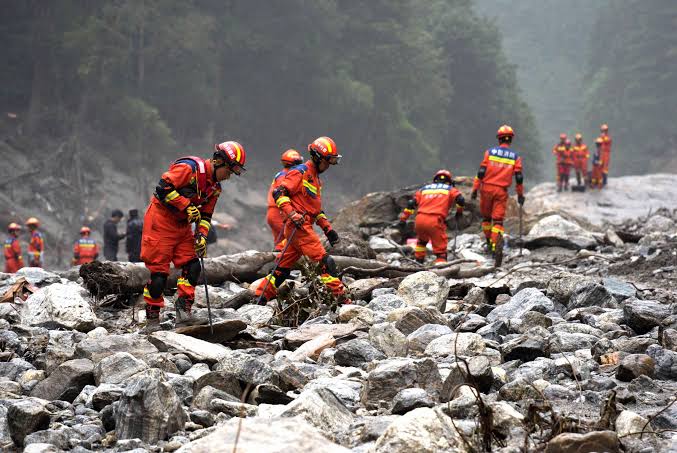
Nepal began burying some of the hundreds killed by a devastating tsunami-like flood on Monday as rescuers continued searching for more than 3,000 people still missing across Nepal and Tibet.
The massive wave of ice, rocks and debris that tore through villages and towns on Wednesday has killed at least 797 people across Nepal and Tibet in China.
Authorities said some bodies may have been swept downstream as far as India.
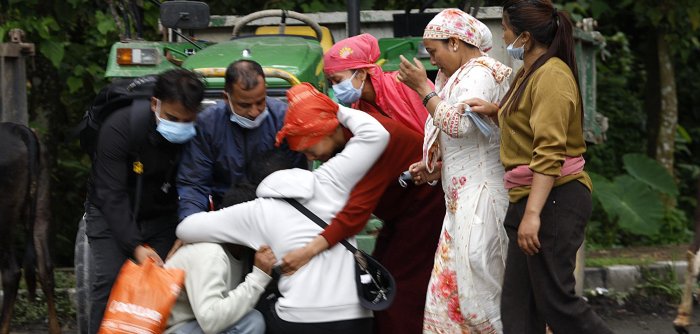
Distraught families continued to gather at hospitals, rescue centres and morgues in search of missing relatives, while others faced the painful task of identifying recovered bodies.
At least 3,048 people remain missing, including tourists and pilgrims travelling to Tibet’s sacred Mount Kailash.
Among those unaccounted for in Nepal are 933 workers at hydropower facilities.
Rescuers Search Tunnel for Trapped Workers
Nepali army troops and engineers continued rescue operations at the Trishuli 3A hydroelectric site, where workers are believed to be trapped inside a tunnel.
Rescuers drilled through debris on Sunday and successfully inserted a pipe into the passage as they worked to reach those feared trapped underground.
Survivors described terrifying scenes as the floodwaters swept through hydropower facilities.
Surendra Dowluri, 33, from India’s Andhra Pradesh state, said raging water overwhelmed the Upper Trishuli-1 site where he was working.
“We heard a very loud sound… and saw that the turbine floor was submerged with slush, and six workers were stuck in that,” Dowluri said after being rescued four days after the disaster.
“We managed to rescue five of them, but one person lost his life,” he said.
He said some workers managed to escape by reaching higher ground and construction areas beyond the path of the torrent.
Overnight rainfall and rising river levels further complicated rescue operations on Sunday, flooding excavation areas before conditions later improved, the Nepali army said.
Glacial Collapse Triggered Disaster
The US Geological Survey said the disaster was triggered by a glacial collapse, which unleashed a destructive wall of water and debris downstream.
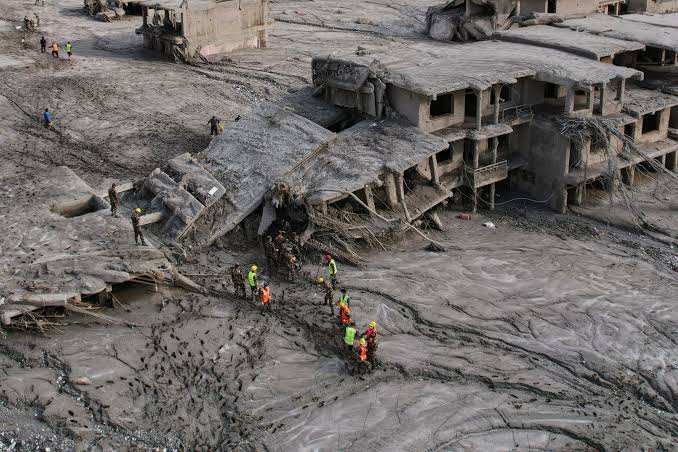
The torrent also created large lakes, raising further concerns among emergency teams monitoring the risk of additional flooding and landslides.
Near the Tibet border, Chinese rescue workers were moved to safety on Sunday after a landslide formed a new lake close to an area already affected by a deadly mudslide.
China has reported 16 deaths and 546 missing people in Tibet.
In Nepal, authorities raised the number of missing people to 2,502 on Sunday, alongside 781 confirmed deaths.
Nepal Begins Burials Amid Morgue Crisis
Overwhelmed by the number of recovered bodies and lacking adequate refrigeration facilities, Nepali authorities have begun burying victims before completing the identification process.
Officials said DNA samples were collected from the bodies to allow families to identify their relatives later and carry out traditional funeral rites.
Relatives have gathered at identification centres where photographs of recovered bodies are displayed on LED screens.
For many families, the search has become increasingly painful.
Shobha Adhikary said she believed she recognised her childhood best friend among images displayed at an identification centre near a makeshift morgue.
“It looks like him, for sure,” she said.
Adhikary said her friend Rajkumar and his wife, Geeta, had both been missing since Wednesday.
“My husband and I are best friends with Rajkumar and his wife Geeta,” she said.
Entire Communities Swept Away
Survivors now face the enormous challenge of rebuilding communities destroyed by the flood.
“All the settlements near the river were swept away,” resident Buddhi Ram Dangol said in Nepal’s Nuwakot district.
“There is nothing left.”
International aid has begun flowing into Nepal as authorities confront what could become one of the country’s most expensive disaster recovery operations.
The United States and Canada each pledged $3.6 million in humanitarian assistance, while the United Kingdom offered $6.8 million.
The United Nations released $2.5 million in emergency funding, while additional support has been pledged by the European Union, the International Federation of Red Cross and Red Crescent Societies and other organisations.
Foreign Minister Shisir Khanal said the cost of reconstruction could run into billions of dollars.
He appealed for specialised equipment, including heavy-lift drones and technology capable of locating people trapped beneath debris.
Khanal also requested forensic testing kits to help identify victims and freezer units to preserve recovered bodies.
He warned that corpses exposed to water could decompose more quickly.
Search Operations Continue in Tibet
In Tibet, more than 2,141 personnel have joined search and rescue operations.
However, difficult terrain and damaged access routes continue to slow efforts to reach the disaster zone.
Chinese rescue workers attempting to establish a route to Gyirong Port, the reported epicentre of the disaster in Tibet, advanced only 285 metres on Sunday.
They still had about 1.25 kilometres to cover before reaching the site, according to state media.
As rescue operations continue across the Himalayan region, thousands of families remain without answers while authorities race to locate survivors and identify the dead.
Author