

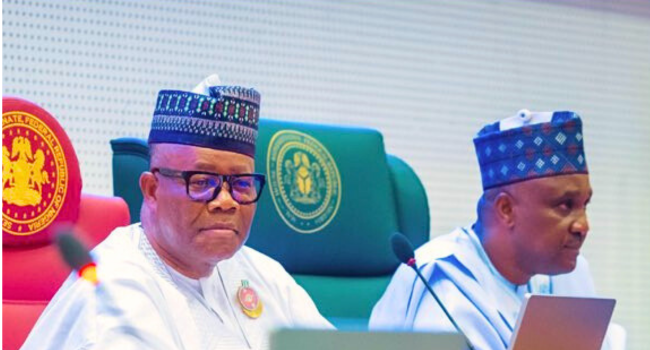
Nigeria’s long-running debate over the establishment of state police moved significantly forward on Thursday as both chambers of the National Assembly advanced constitutional amendments aimed at decentralising policing and strengthening the country’s security architecture.
The House of Representatives approved the proposed legislation following overwhelming support from lawmakers, while the Senate passed the bill for second reading, signaling growing bipartisan backing for one of the country’s most consequential security reforms.
The proposal seeks to transfer policing from the Exclusive Legislative List to the Concurrent Legislative List, enabling individual states to establish and manage their own police services alongside the Federal Police.
House Approves State Police Constitutional Amendment
At the House of Representatives, lawmakers voted overwhelmingly in favour of the amendment after a manual voting process was adopted due to technical issues affecting the electronic voting system.
Of the 290 lawmakers present during plenary, 289 voted in support of the bill, while one member voted against it.
Announcing the result, Speaker Tajudeen Abbas said:
“In attendance for the exercise are 290 members, out of which 289 voted in favour of state police. One member voted against, and there’s no nay vote.”
The constitutional amendment bill, which contains 18 clauses, successfully passed its third reading after lawmakers met the constitutional requirement for a two-thirds quorum.
According to Abbas, the approval represents a critical step toward creating a policing structure capable of responding more effectively to local security realities.
He stated:
“By passing this bill, the House has taken a decisive constitutional step towards creating a policing framework that is more responsive to local realities while remaining firmly anchored within the unity and sovereignty of the Federal Republic of Nigeria.”
A brief disagreement emerged before voting commenced when a lawmaker representing Birnin Gwari/Giwa Federal Constituency, Bashir Zubairu Usman, protested that members had only received the amendment document on the day of voting. However, the objection was dismissed, and proceedings continued.
Senate Advances State Police Bill
In the Senate, lawmakers approved the bill for second reading and referred it to the Senate Ad-hoc Committee on the Review of the 1999 Constitution for further consideration.
Leading debate on the proposal, Senate Leader Opeyemi Bamidele described state police as a necessary reform to address increasingly complex security threats across the country.
According to him, decentralised policing would improve intelligence gathering, community engagement, and response times.
“The establishment of state police will improve intelligence gathering: Local police officers are better equipped to obtain actionable intelligence from communities because they understand local languages, customs and social structures.”
Bamidele argued that Nigeria’s current security challenges—including terrorism, banditry, kidnappings, communal conflicts, armed robbery, pipeline vandalism, cultism and cybercrime—require a more flexible and localised policing framework.
How Federal and State Police Powers Would Be Shared
One of the most significant aspects of the amendment is the creation of separate Federal Police and State Police structures with clearly defined responsibilities.
Under the proposed constitutional changes:
- The Federal Police would maintain responsibility for national security, interstate crimes, terrorism, organised crime, border protection, cybercrime and federal assets.
- State Police would manage local security operations within their respective states.
- States would be required to pass enabling laws before launching operational police formations.
- State police services must meet nationally prescribed minimum standards before becoming operational.
The amendment also states that the Federal Police would continue to perform policing duties in any state that has not yet established its own police service.
Safeguards Against Abuse
Addressing concerns that governors could misuse state police forces for political purposes, supporters of the bill highlighted several oversight mechanisms built into the proposal.
These include:
- State Police Service Commissions
- Federal oversight through the Federal Police Service Commission
- Uniform national policing standards
- Legislative confirmation of senior police appointments
- Federal intervention during severe breakdowns of law and order
- Constitutional procedures for removing senior police officers
Bamidele insisted that these safeguards were designed to balance autonomy with accountability.
“This Bill adequately addresses those concerns through several safeguards.”
Appointment and Removal of Police Chiefs
The amendment proposes that:
- The Inspector-General of Police would continue to be appointed by the President based on recommendations from the National Police Council and subject to National Assembly confirmation.
- State Commissioners of Police would be appointed by governors based on recommendations from the National Police Council and confirmed by State Houses of Assembly.
The proposal also establishes detailed procedures for the removal of both federal and state police chiefs, including cases involving misconduct, breaches of regulations, fraud-related convictions, bankruptcy, or mental incapacity.
Federal Intervention Powers Retained
Although state police would have operational autonomy, the amendment preserves federal intervention powers in certain circumstances.
The Federal Police may intervene when:
- There is a complete breakdown of law and order.
- A state police service is unable to manage a major security threat.
- A governor formally requests federal assistance.
- A state police formation becomes inoperative due to administrative or financial challenges.
The Federal Capital Territory would remain under the exclusive jurisdiction of the Federal Police.
Nigeria’s Arms Imports Rise by 48%
Meanwhile, data released by the National Bureau of Statistics revealed that Nigeria spent N32.5 billion on arms imports during the first quarter of 2026.
The figure represents a 48 per cent increase compared to the N22 billion recorded during the same period in 2025.
Security analyst Chidi Omeje described the increase as a reflection of the country’s expanding security demands.
“Every part of the country is assailed by one level of insecurity or another.”
He called for greater investment in weapons procurement, personnel training, surveillance technology and operational capacity.
Experts Divided Over State Police
Security stakeholders remain split on the proposal.
Retired Assistant Inspector General of Police Ali Amodu backed the initiative, urging lawmakers to approve the reform and arguing that decentralised policing could improve security outcomes.
Retired Commissioner of Police Lawrence Alobi also expressed support but called for wider consultations with security professionals and other stakeholders.
However, retired Commissioner of Police Ladodo Rabiu opposed the proposal, citing funding concerns, infrastructure challenges and potential conflicts between federal and state police formations.
“There will be clashes between state and federal police. If federal police are operating in a state, there will be conflict over jurisdiction.”
State Police Remains Best Security Option, Adviser Says
Also supporting the initiative, Sokoto State Governor’s Special Adviser on Security Matters, Col. Ahmed Usman (retd), described state police as one of the most practical solutions to Nigeria’s growing security challenges.
He argued that redeploying police officers to their states of origin would improve intelligence gathering and community policing because officers would already possess local knowledge of culture, language and terrain.
“State police remain a viable solution to Nigeria’s security challenges. It will enhance intelligence gathering, improve response time, and strengthen community-based policing.”
Author