
Nigeria’s headline inflation rate eased marginally to 15.39 per cent in August 2026, as food price pressures weakened sharply and monthly inflation slowed to its lowest level in recent months, according to the National Bureau of Statistics.
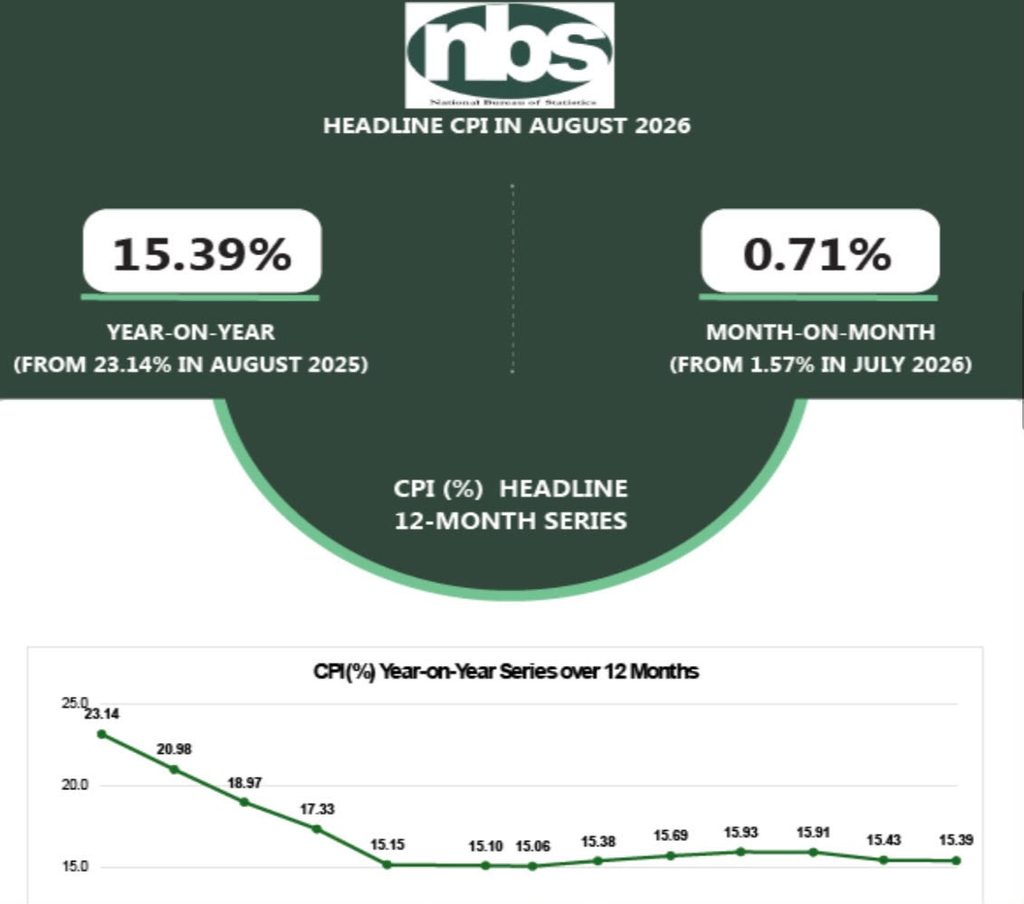
The NBS disclosed this in its Consumer Price Index report for August 2026 released on Monday.
The latest annual inflation figure represents a 0.04 percentage-point decline from 15.43 per cent in July and a substantial moderation from the 23.14 per cent recorded in August 2025.
The NBS said the August figure reflected a slower increase in the average price level compared with the previous month.
Despite the decline in the annual rate, the Consumer Price Index, which tracks changes in the prices of goods and services consumed by households, rose to 146.3 points in August from 145.3 points in July.
On a month-on-month basis, inflation slowed sharply to 0.71 per cent in August from 1.57 per cent in July, indicating that prices continued to rise but at a considerably slower pace.
Food Inflation Records Sharp Slowdown
Food and non-alcoholic beverages remained the largest contributor to annual inflation, accounting for 6.16 percentage points of the headline rate.
Restaurants and accommodation services contributed 1.99 percentage points, transport accounted for 1.64 points, while housing, water, electricity, gas and other fuels contributed 1.30 points.
Food inflation stood at 19.57 per cent year-on-year in August, down substantially from 25.30 per cent in August 2025.
The monthly picture was even more pronounced. Food inflation fell to 1.02 per cent in August from 5.56 per cent in July, signalling a significant slowdown in the pace at which food prices increased.
The NBS attributed the moderation to changes in the average prices of several food items, including palm oil, carrots, pepper, onions, cassava flour, beef, yam flour, water yam, melon, fresh ginger, fresh fish, Irish potatoes, wheat grain, frozen chicken and turkey meat.
Core Inflation Also Moderates
Core inflation, which excludes volatile agricultural produce and energy prices, also declined to 13.29 per cent year-on-year in August, compared with 22.93 per cent in the same month of 2025.
On a monthly basis, core inflation turned negative, falling to -0.06 per cent from 0.15 per cent in July.
The figures point to a broad moderation in price pressures, although inflation remained uneven across different parts of the country.
Wide Differences Across States
Urban inflation stood at 15.88 per cent year-on-year, compared with 14.23 per cent in rural areas.
However, rural prices increased at a faster monthly pace in August. Rural month-on-month inflation rose to 1.79 per cent from 0.78 per cent in July, while urban monthly inflation slowed sharply to 0.28 per cent from 1.90 per cent.
At the state level, Lagos recorded the highest headline inflation rate at 23.68 per cent, followed by Zamfara at 22.56 per cent and Enugu at 22.06 per cent.
Sokoto recorded the lowest headline inflation rate at 2.11 per cent.
Food inflation was highest in Adamawa at 38.85 per cent, followed by Zamfara at 37.96 per cent and Bayelsa at 36.20 per cent.
The NBS cautioned, however, that differences in consumption patterns and the weights assigned to items in the Consumer Price Index mean that direct comparisons between states may be misleading.
The August figures mark a continued moderation in Nigeria’s annual inflation rate, with the sharp slowdown in monthly food inflation emerging as one of the strongest drivers of the latest decline.
Author