
$46bn Investment to Drive Dangote Refining Capacity Expansion
Dangote Group is preparing its next major leap in African industrialisation, unveiling plans to lift its total refining capacity across the continent to 2.1 million barrels per day, backed by a fresh $46bn investment programme running from 2026 to 2028.
The expansion strategy, disclosed during a high-level visit by a Congolese delegation to the Dangote Petroleum Refinery in Lagos, combines the group’s existing 1.4 million barrels per day capacity in Nigeria with a newly planned 700,000 barrels per day refining complex in Kenya, designed specifically to serve East African markets. The additional capital, spread across the group’s refining, cement and fertiliser businesses, forms part of a broader drive to accelerate industrialisation across the continent.
The visit itself carried significance well beyond a routine facility tour. It marked the start of formal discussions between the national oil company of the Republic of the Congo, the Société Nationale des Pétroles du Congo, and Dangote Petroleum Refinery & Petrochemicals, centred on a potential strategic partnership aimed at strengthening the Republic of the Congo’s supply of refined petroleum products while advancing regional energy cooperation and industrial integration across Africa.
Leading the Congolese delegation, SNPC Managing Director Maixent Raoul Ominga did not hide his admiration for what he encountered at the Lagos facility, describing it as a strategic asset for the entire continent and signalling clear interest in building a long-term relationship with Dangote. “We have visited this remarkable refinery, which represents a major industrial achievement for Africa. The Republic of the Congo has refining capacity and we are keen to explore strategic cooperation that will help strengthen the supply of refined petroleum products while creating value for both organisations,” Ominga said, according to a statement issued by Dangote Group.
He indicated that talks between the two organisations had ranged widely, touching on possible collaboration in refining, petroleum products supply, energy security, industrial development, and knowledge sharing — a scope suggesting the partnership under discussion could extend well beyond a simple product-supply arrangement into deeper technical and strategic cooperation.
Ominga was equally emphatic in praising what Dangote’s refinery represents for the continent’s industrial ambitions more broadly, framing it as proof that Africa is capable of financing, building and operating world-class industrial infrastructure on its own terms. He described the facility as an important milestone in the continent’s industrial transformation. His praise extended beyond the refinery itself, too — he specifically commended the Dangote Group’s investments in the Republic of the Congo’s cement sector, noting that they have strengthened local industrial capacity, expanded production, and improved access to construction materials for Congolese communities.
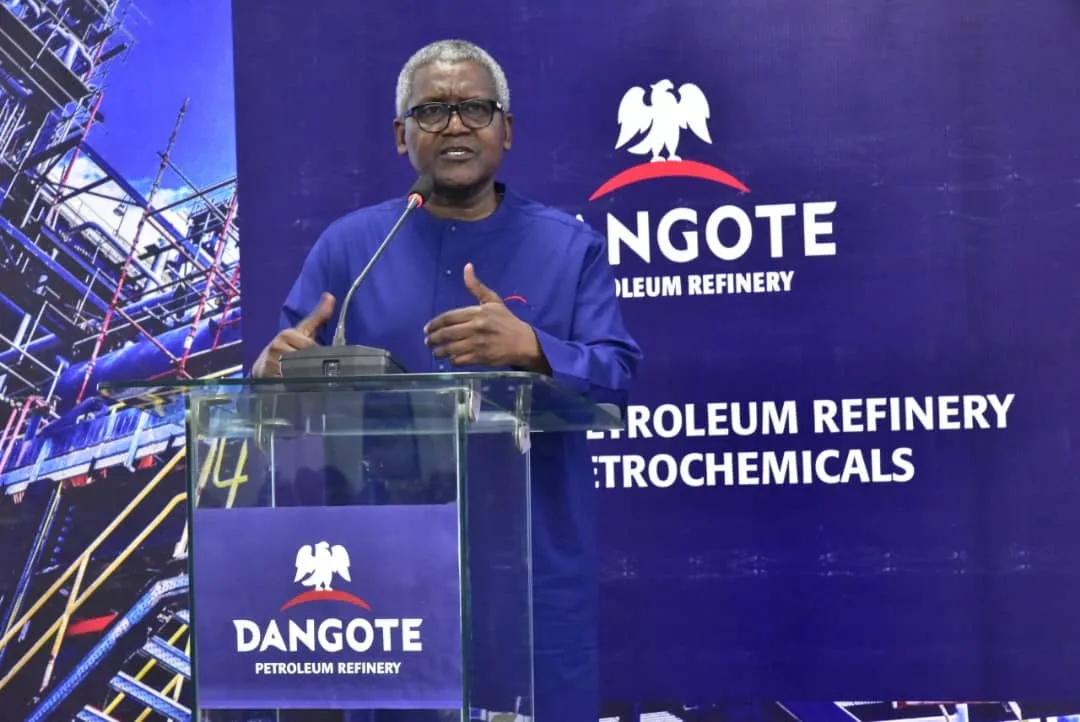
For his part, President and Chief Executive of Dangote Industries Limited, Aliko Dangote, used the occasion to underscore the pan-African orientation guiding the group’s investment strategy. “We are for Africa, not just Nigeria. Tell us what you need, and we will see how we can work together,” Dangote said, a statement that positioned the Lagos refinery not merely as a Nigerian industrial asset but as a platform intended to serve the continent’s broader energy and industrial needs.
Dangote also pointed to the refinery’s role in reshaping fuel standards across the region, noting that the facility has established a new benchmark for fuel quality in Africa by producing petroleum products that meet the highest international specifications. He argued that this has translated into improved access to cleaner fuels across the continent, while simultaneously reducing Africa’s dependence on refined petroleum products imported from outside the continent — a dependence that has long been viewed as a structural weakness in African energy security.
The technical detail behind the expansion plans came from Group Vice President, Oil and Gas at Dangote Industries Limited, Devakumar Edwin, who used the visit to lay out the group’s long-term growth roadmap. Edwin confirmed that the strategy would take the group’s total refining capacity to 2.1 million barrels per day, made up of the existing 1.4 million barrels per day capacity in Nigeria alongside the planned 700,000 barrels per day complex earmarked for Kenya to serve East African demand.
Edwin also went further, disclosing the scale of capital the group intends to deploy to achieve this expansion. He confirmed plans for an additional $46bn in investment between 2026 and 2028, spread across the group’s refining, cement and fertiliser operations — an investment programme framed explicitly as part of Dangote’s broader push to accelerate industrialisation across the African continent, rather than a narrower, single-country expansion effort.
Taken together, the engagement between SNPC and Dangote Industries reflects a shared commitment from both sides to deepen African energy cooperation, strengthen regional value chains, and promote greater self-sufficiency in refined petroleum products, at a moment when the continent is actively working toward enhanced energy security and increased intra-African trade. Should the discussions between the two organisations progress into a formal partnership, it could mark a significant step toward reducing the Republic of the Congo’s reliance on refined product imports from outside Africa, while giving Dangote a further foothold in Central African energy markets.
The Lagos meeting drew a notable roster of officials from both sides. Also present were Group Executive Director, Commercial, Oil and Gas at Dangote Industries Limited, Fatima Aliko Dangote; Adviser to the President of the Republic of the Congo, Peggy Ndongo; and advisers to the SNPC Managing Director, Aymar Ebiou and Norbert Mabiala — a lineup underscoring the level of seniority both organisations attached to the discussions, and hinting at how seriously both sides appear to be treating the prospect of a formal strategic partnership going forward.
Author