
Minister Odumegwu-Ojukwu Issues Final Call to Nigerians in South Africa
The Federal Government has moved to evacuate another 270 Nigerian nationals from South Africa, deepening its emergency repatriation drive as renewed xenophobic violence and worsening security conditions continue to threaten citizens abroad.
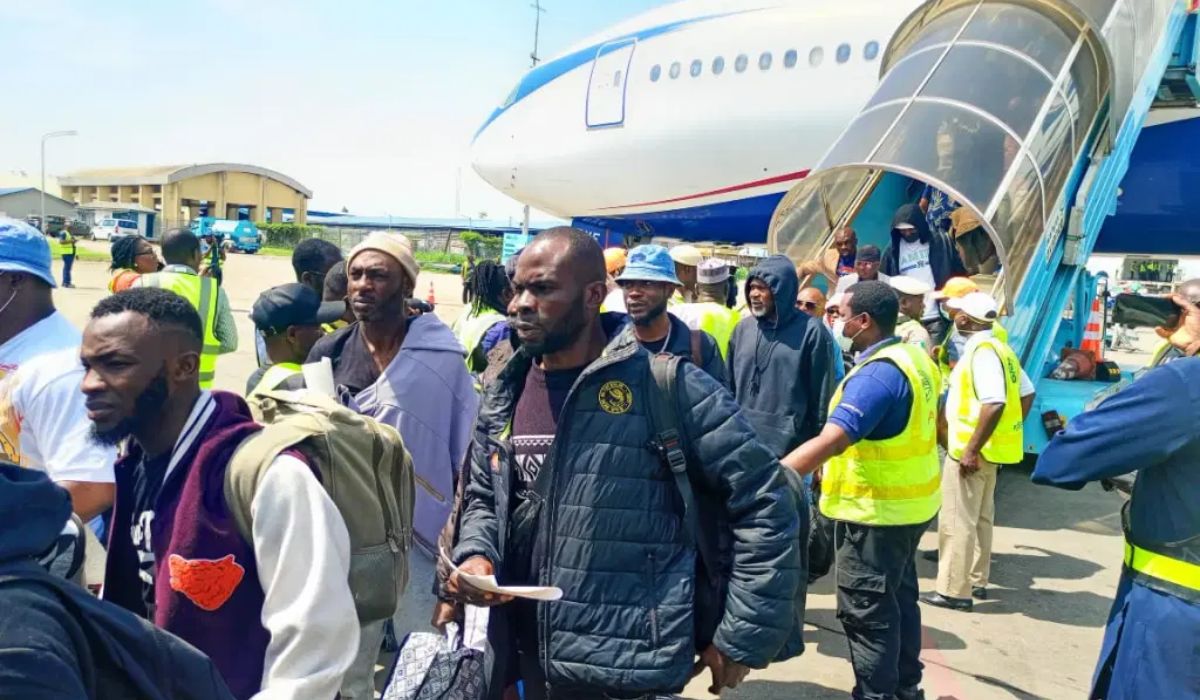
The fresh evacuation will unfold aboard the fourth special flight operated by Air Peace, scheduled to depart Lagos for Johannesburg on Tuesday, July 7, 2026, before returning to Nigeria with the affected citizens on board.
According to the Ministry of Foreign Affairs, the aircraft is expected to depart Lagos at 3:30 p.m. and return with 270 registered evacuees, representing another phase in the government’s repatriation programme for Nigerians willing to return home. The flight is expected to leave Johannesburg at midnight and arrive at the Murtala Muhammed International Airport, Lagos, at about 5:00 a.m. on Wednesday, July 8, 2026, subject to operational conditions.
The spokesperson of the Ministry of Foreign Affairs, Kimiebi Ebienfa, confirmed the arrangement in a statement issued on Monday in Abuja, noting that an Air Peace aircraft deployed for the evacuation exercise would depart Lagos for Johannesburg the same day. The operation marks the fourth evacuation flight organised by the Federal Government in its ongoing efforts to facilitate the voluntary return of Nigerian citizens from South Africa.
As the flight prepares for departure, the Federal Government has issued what amounts to a final call to Nigerian nationals still in South Africa, urging them to complete their documentation and take advantage of the ongoing evacuation programme amid persistent xenophobic attacks and growing security concerns.

Minister of Foreign Affairs, Amb Bianca Odumegwu-Ojukwu, said the government remained deeply concerned about the safety of Nigerians living in South Africa, particularly following the deaths of two citizens, Musa Yunana Joe and Charles Iroegbu. In a statement posted on her X handle on Monday, the minister said Nigeria was monitoring developments closely and had extended evacuation arrangements to enable more citizens to return home safely.
“Nigeria remains concerned about the safety of its citizens in South Africa as a result of the ongoing Xenophobic protests and attacks on migrants, and even more so following the deaths of 2 Nigerians, Musa Yunana Joe and Charles Iroegbu, during these unfortunate events,” she stated.
The minister called on South African authorities to thoroughly investigate the incidents and ensure those responsible are prosecuted. “We demand that South African authorities urgently investigate the incidents and bring those responsible to justice, and we are urging our citizens who consider their lives at risk to take advantage of the Federal Government-sponsored evacuation flights to be transported home,” she said.
According to her, despite previous evacuation operations, there were no indications that the security situation was improving. “There are no signs that the situation is improving,” Odumegwu-Ojukwu noted.
She recalled that following the earlier evacuation of Nigerians in three separate operations, President Bola Tinubu approved an extension of the programme beyond the June 30 deadline. “Following the earlier evacuations of our citizens in three separate operations, President and Commander-in-Chief of the Armed Forces of the Federal Republic of Nigeria, President Bola Ahmed Tinubu GCFR, extended the evacuations beyond the June 30 deadline, with the fourth evacuation flight having arrived in Nigeria on 3rd July 2026,” she said.
The minister urged Nigerians still in South Africa to make use of the available seats on the evacuation flights, stressing that the government had provided sufficient capacity to accommodate those willing to return. “Our citizens are strongly advised to take advantage of this extension and utilise the full capacity of the aircraft,” she added.
She disclosed that another evacuation flight would depart for Johannesburg on Tuesday, July 7, while the final evacuation aircraft was expected to arrive in South Africa on July 10. “Another evacuation flight will leave for Johannesburg tomorrow, Tuesday, 7th July, to bring home our citizens. The last evacuation flight is expected to arrive in South Africa on 10th July. Our nationals are again advised to weigh the risks regarding whether to remain or return,” she said.
The minister further appealed to those yet to decide to prioritise their safety, warning that material losses could be recovered but lives could not. “For many still sitting on the fence, they should do well to note that properties and investments lost can be replaced, but not lives lost,” she said.
The unfolding evacuation effort underscores the scale of the crisis facing Nigerians in South Africa, where renewed attacks on migrants have forced the government into a sustained, multi-flight repatriation campaign rather than a single, one-off rescue operation. With a fifth flight already scheduled and a firm arrival date set for July 10, the government’s messaging has shifted from general reassurance to a direct, urgent appeal: those still undecided are being asked to weigh personal safety above material considerations, and to act before the window of extended evacuation support closes.
For families of the two Nigerians who lost their lives in the violence, Musa Yunana Joe and Charles Iroegbu, the government’s renewed evacuation push offers little immediate comfort, though the minister’s public demand for accountability from South African authorities signals that Abuja intends to keep pressure on Pretoria even as the airlifts continue. Whether that pressure translates into concrete prosecutions remains to be seen, but for now, the priority on the ground remains getting as many willing citizens onto outbound flights as the extended evacuation window allows.
The scale of this fourth operation, 270 registered evacuees on a single chartered flight, illustrates just how significant the exodus has become since the current wave of xenophobic hostility took hold.
Each of the four flights organised so far has followed a broadly similar pattern: a chartered Air Peace aircraft departing Lagos in the afternoon, touching down in Johannesburg later that day, and returning overnight with citizens who have chosen to abandon jobs, businesses, and, in many cases, years of settled life in South Africa rather than risk further exposure to violence. That repeated pattern, now stretching to a fourth and soon a fifth flight, suggests the crisis driving these departures is neither isolated nor short-lived.
Nigeria’s diaspora community in South Africa has long been one of the largest African migrant populations in the country, drawn historically by relatively stronger economic opportunities compared to other parts of the continent. That same visibility, however, has periodically made Nigerians and other African migrants targets during recurring waves of xenophobic sentiment, often fuelled by local grievances over jobs, housing, and crime that get redirected toward foreign nationals rather than addressed through domestic policy solutions.
The current wave, serious enough to prompt not one but multiple government-sponsored evacuation flights within a matter of weeks, appears to fit that troubling historical pattern, even as officials in Abuja frame their response as measured and citizen-focused rather than alarmist.
President Bola Tinubu’s decision to extend the evacuation programme beyond its original June 30 deadline is itself a signal of how the government’s risk assessment has evolved since the crisis began. An initial deadline suggests the government anticipated a relatively contained situation that could be resolved through a limited number of flights.
The extension, and the fact that a fourth flight has now landed with a fifth already scheduled to arrive by July 10, indicates that the security situation on the ground has not improved quickly enough to justify winding the programme down on schedule. Minister Odumegwu-Ojukwu’s own remark, that there are no signs the situation is improving, reinforces that reading directly from the government’s own assessment rather than outside speculation.
The minister’s public demand that South African authorities investigate the deaths of Musa Yunana Joe and Charles Iroegbu and prosecute those responsible also carries diplomatic weight beyond the immediate evacuation logistics.
Nigeria and South Africa maintain significant trade, investment, and people-to-people ties, and Abuja’s public statements on this issue, posted directly on the minister’s X handle rather than buried in a low-profile diplomatic note, suggest a deliberate choice to keep the matter visible both to the Nigerian public and to South African officials. That visibility strategy appears aimed at applying steady public pressure for accountability even as the practical evacuation work continues in parallel.
For Nigerians still weighing whether to stay in South Africa or return home, the government’s messaging has become progressively more direct with each flight. Where earlier communications may have simply informed citizens of available evacuation slots, the minister’s latest statement explicitly urges those undecided to prioritise their safety over financial considerations, framing the choice in stark terms: properties and investments lost can be replaced, but lives lost cannot.
That framing reflects a government seemingly aware that economic ties, businesses built, jobs held, investments made, are precisely what keep many Nigerians in South Africa despite the mounting security risk, and is attempting to counter that pull with an equally direct appeal to personal safety.
With the fifth and reportedly final evacuation flight expected to arrive in South Africa by July 10, the coming days represent a narrowing window for Nigerians who have not yet decided whether to leave. The government has signalled that the current extended phase of the programme will not run indefinitely, even as it has already surpassed its original deadline once. For now, attention turns to Tuesday’s Air Peace flight, which is expected to touch down in Lagos in the early hours of Wednesday morning carrying another 270 citizens who have chosen to return home rather than continue navigating the uncertainty of the ongoing unrest.
Beyond the immediate logistics, the recurring nature of these evacuation operations raises broader questions about the long-term safety of Nigerian nationals in South Africa and the adequacy of existing bilateral mechanisms for protecting migrant communities during periods of civil unrest. A fourth chartered flight within weeks, following three earlier operations, points to a crisis that has required sustained, rather than one-off, government intervention. That pattern may well shape how Nigeria’s foreign affairs establishment approaches future migrant safety concerns in South Africa and elsewhere on the continent, particularly if xenophobic sentiment resurfaces in subsequent months after the current evacuation window closes.
For the Nigerian diaspora community that chooses to remain in South Africa despite the government’s repeated safety warnings, the coming weeks will likely be defined by heightened caution, closer coordination with Nigerian consular officials, and continued monitoring of the security situation by the Ministry of Foreign Affairs.
Those who opt to return, meanwhile, will join a growing number of citizens who have already been repatriated across the first three evacuation operations, adding to the logistical and, in many cases, economic challenge of reintegration back home after uprooting lives built over years in South Africa. How the Federal Government manages that longer reintegration process, beyond simply providing the flights home, may ultimately determine whether the evacuation programme is remembered as a temporary emergency response or the first phase of a more permanent shift in how Nigerians view long-term settlement in South Africa.
Author