
Dangote Petrol Price War, Who Will Cut Prices First?
Nigerian motorists hoping for petrol prices to fall meaningfully below N1,000 per litre may need to wait for one specific trigger: a price war between the Dangote Petroleum Refinery and the growing pool of independent fuel importers now active in the market.
Crude oil prices have crashed to around $70 per barrel following the gradual reopening of oil supply through the Strait of Hormuz, and many Nigerians expected that decline to translate into pump prices closer to what was recorded before the US-Iran war began on 28 February. Instead, prices have stayed stubbornly elevated, with only marginal reductions coming from the Dangote refinery, which remains the country’s dominant supplier of petrol, diesel and aviation fuel.
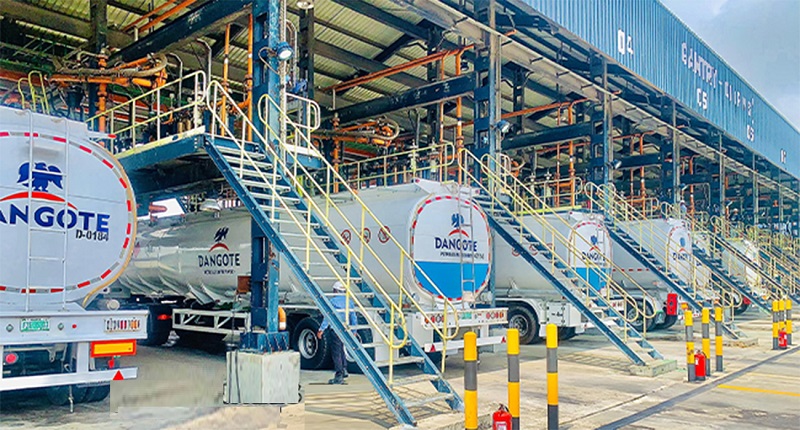
Since the fourth quarter of 2024, Dangote’s refinery has effectively functioned as Nigeria’s price setter, a role previously held by the Nigerian National Petroleum Company Limited back when it was virtually the country’s sole petrol importer due to the absence of functioning domestic refineries. As pressure mounts for prices to fall in line with the global crude slide, public attention has understandably turned toward Dangote — but the refinery appears to be pointing the finger elsewhere.
In an exclusive conversation, a senior Dangote Group official argued that the Federal Government should instead be pressing the importers it has licensed to bring in fuel to lower their own prices. The official, who spoke on condition of anonymity given the sensitivity of the matter, expressed surprise that importers bringing in cheaper Russian-origin petrol had not passed on the savings to consumers. “The Federal Government has been giving huge quantities of import licences for the past few months. And the importers bring cheaper Russian products (cheaper because they are banned commodities). So, why are the importers not selling cheaper?” the source asked.
When it was put to the official that importers might simply be waiting for Dangote to move first, he pushed back on the assumption entirely. “How can they be waiting for us when their vessels are arriving every day?” he asked.
The Dangote source also pointed to the refinery’s own constraints, disclosing that it still holds significant volumes of crude purchased at higher prices before the recent decline — inventory that makes an immediate, sharp cut in fuel prices logistically difficult. He explained that the refinery maintains substantial crude storage capacity, with further cargoes already en route to Nigeria and additional volumes locked into forward purchase agreements signed before crude prices fell.
“We have huge crude oil storage capacity in our crude tank farm. Further, there would be crude oil in the ships, at different points, sailing from the country of origin to Nigeria. In addition, there would be crude oil under forward purchases, which have yet to be shipped. But, since the country trusts importers, let them go and sell at the low imported price plus profit,” he said.
He also raised a separate grievance about domestic crude supply, arguing that the government is not providing the refinery with sufficient crude oil, forcing it to import its own feedstock even as it exports refined products. “The government is giving us small quantities of crude oil. So, we import our crude oil and export our products. If you say the masses will be at the receiving end, you should know that it’s a sad situation for the investor too,” he said.
Figures from the Major Energies Marketers Association of Nigeria, whose membership includes the country’s major fuel importers, showed the landed cost of imported petrol at N1,023 per litre on Wednesday, compared with Dangote’s gantry price of N1,075 — a meaningful gap on paper that has yet to translate fully into cheaper pump prices for ordinary Nigerians.
Chinedu Ukadike, National Publicity Secretary of the Independent Petroleum Marketers Association of Nigeria, offered an explanation for that disconnect, describing the standoff between Dangote and the importers as something of a strategic waiting game. “This business is like a ding-dong game. Dangote is a refiner. It is being sparked by these licences that were given to importers. And these importers are also very wary of Dangote’s antics and the strength of the price at purchase. So, it becomes very sceptical for importers to go out and continue to import unprecedentedly without watching what Dangote’s next move would be,” he said.
Ukadike pointed specifically to Dangote’s old crude stock, purchased during the period when the Strait of Hormuz was effectively closed, as a factor slowing the pace of price cuts. “Now, Dangote, in its own stance, is also talking about the old crude stock that it bought when the Strait of Hormuz was locked. And it needs to exhaust refining those crude stocks before it can reduce prices significantly. Though the refinery has been reducing prices gradually.
I know that this price reduction is systematic. So, this is what I call a ding-dong game. Importers are wary that because of Dangote’s significant fiscal position in the oil and gas industry, it might make a drastic reduction that would affect those who have imported. And they will go home with a lot of losses; even we independent marketers are losing money with the recent reductions by Dangote,” he said.
At the depot level, petrol loading prices showed mixed movement on Thursday, with modest reductions dominating the Lagos market and diesel prices easing at several major depots. In Lagos, a number of depots cut Premium Motor Spirit prices by between N3 and N4 per litre. African Terminal, Bono, Emadeb, Integrated and Sahara lowered their ex-depot prices to N1,117 per litre from N1,120, while Aiteo reduced its price to N1,115 from N1,118. Techno Oil also cut its price by N4 to N1,117 per litre.
Not every depot moved, however. Dangote Refinery, MRS, NIPCO and Pinnacle held their prices steady at N1,126, N1,125, N1,118 and N1,121 per litre respectively, underscoring how selective the price adjustments have been across the market. These figures reflected the situation before Dangote subsequently announced a N50 cut to its petrol gantry price on Thursday.
Diesel prices also softened in parts of the Lagos market. Dangote Refinery cut its diesel loading price by N12 to N1,488 per litre from N1,500, while Duport reduced its price by N5 to N1,450 per litre. Aiteo held its diesel price steady at N1,450 per litre, and NIPCO’s price remained unchanged at N1,460 per litre.
The Port Harcourt market told a somewhat different story, with a firmer pricing trend for petrol. Matrix raised its ex-depot price by N2 to N1,127 per litre, while Sigmund increased its price by N4, also to N1,127 per litre. Bulk Strategic held its price at N1,123 per litre, and Liquid Bulk was quoted at N1,121 per litre. Diesel prices in Port Harcourt were unchanged, with Matrix maintaining N1,520 per litre and Sigmund holding at N1,518 per litre.
These depot-level movements unfolded against a backdrop of continued softening in international crude prices, with Brent crude trading around $71 per barrel on Thursday amid easing supply concerns tied to progress in US-Iran talks — a trend that has fuelled expectations globally that fuel prices should continue falling.
The slow pace of domestic price reductions has not gone unnoticed at the top levels of government. The Minister of State for Petroleum Resources (Oil), Heineken Lokpobiri, warned on Monday that the government would not tolerate profiteering or other practices exploiting fuel consumers, even as he acknowledged that the era of government-fixed petrol prices is over.
He stressed that deregulation does not mean regulators should abdicate their responsibility to protect consumers, speaking in Abuja against a backdrop of public frustration that gantry prices have failed to fall in step with crude, which has dropped from a high of $120 per barrel during the US-Iran war to around $70 per barrel today. A day earlier, the Federal Competition and Consumer Protection Commission had raised similar concerns about possible consumer exploitation in the downstream petroleum sector.
Fuel marketers, for their part, have pushed back hard against any suggestion of government-imposed price controls. Ukadike reiterated that many marketers are already operating at a loss following Dangote’s recent price reductions, rejecting allegations of profiteering outright. “Marketers will shut down if they try somehow to enforce price control. We are going to shut down our stations nationwide. You can’t be regulating a deregulated market. You can’t tell me how much to sell my product without trying to know how much I bought it,” he warned.
With Dangote citing old crude stock as a constraint on faster cuts, importers wary of triggering losses by moving first, and government caught between deregulation principles and mounting public pressure, Nigerians are left watching to see which side of the market will blink first — and how long it will take before falling crude prices translate into real relief at the pump.
Author