
NRC Lagos Rail Licence Sets Example for Other States to Invest in Rail
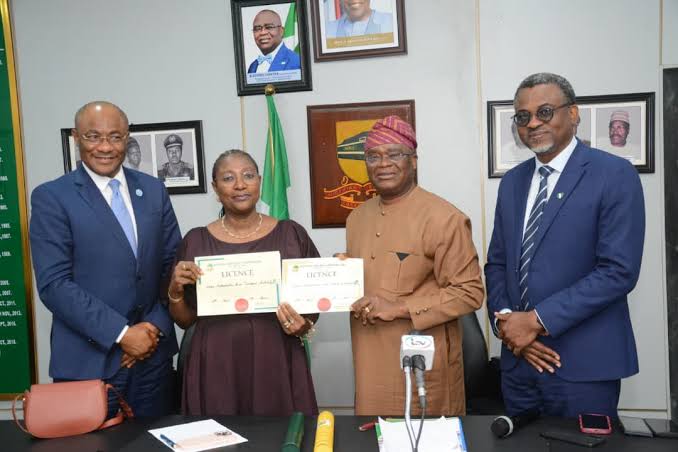
Nigeria’s railway sector NRC has crossed a historic threshold. After 128 years as the country’s sole railway operator, the Nigerian Railway Corporation NRC has formally handed Lagos State a Permanent Operating Licence, opening the door to a new era of multiple operators within a regulated national rail system.
The licence, presented through the Lagos Metropolitan Area Transport Authority, authorises the Lagos State Government to run rail services on the shared corridor under the existing Track Sharing Agreement, while also clearing the way for the state to operate additional rail systems in the future.
At the presentation ceremony, NRC Managing Director Dr. Kayode Opeifa framed the moment as nothing short of a watershed in Nigeria’s railway history — a deliberate transition away from monopoly toward a more collaborative, regulated model. “For 128 years, since 1898, the Nigerian Railway Corporation has remained the sole developer and operator of railway services across Nigeria and, until recently, beyond our borders through rail connections with neighbouring countries. Today, we formally change that narrative not by abdicating our statutory roles and responsibilities, but by expanding our horizons and embracing the global best practice of encouraging multiple operators within a regulated rail system,” Opeifa said.
He was careful to situate the licence within a much longer partnership between the NRC and Lagos State, one focused on modernising rail transport and improving urban mobility across the state. That partnership, he explained, traces back to April 2012, when then-President Goodluck Jonathan approved the transfer of two federal rail tracks to the Lagos State Government to support development of the Lagos Rail Mass Transit Red Line. That early decision, Opeifa noted, laid the groundwork for one of Nigeria’s most ambitious urban rail projects — a line that eventually began passenger operations on October 15, 2024, following its inauguration by President Bola Tinubu.
The road to Tuesday’s permanent licence ran through an interim stage. Opeifa recalled that the NRC had earlier issued Lagos State a temporary operational licence to enable implementation of the Track Sharing Agreement, while the corporation closely monitored the Red Line’s operational performance over time.
“I recall that a little over a year ago, the NRC granted the Lagos State Government a temporary operational licence to facilitate the implementation of the Track Sharing Agreement, pending the issuance of a permanent operating licence following satisfactory operational assessment,” Opeifa said. “Today, we take another important step in strengthening that partnership by presenting a Permanent Operating Licence to the Lagos State Government through the Lagos Metropolitan Area Transport Authority. This licence formally grants LAMATA access to operate services on the shared corridor in accordance with the Track Sharing Agreement, while conferring the rights and obligations contained therein.”
Beyond the immediate corridor, Opeifa said the licence also empowers the Lagos State Government to operate other rail systems in line with international standards — a significant expansion of the state’s regulatory latitude going forward. He pointed, too, to a less visible dimension of the NRC-Lagos partnership: the training and capacity development of personnel operating the Red Line, which he described as a clear demonstration of the benefits that flow from institutional collaboration.
Opeifa reserved particular praise for Lagos State’s sustained investment in public transportation, especially within the rail subsector, noting that the state’s acquisition of rolling stock and continued infrastructure development reflect strong political will and long-term planning rather than short-term gestures. “I sincerely appreciate the Lagos State Government for its confidence in the Nigerian Railway Corporation and for its unwavering commitment to this collaboration. The development of modern rail infrastructure requires foresight, substantial capital investment, and sustained political will, all of which Lagos State has consistently demonstrated,” he said.
He situated Lagos’s achievement within a broader vision for Nigerian transportation, describing rail as the backbone of efficient mass transit in major cities worldwide and arguing that continued investment in the sector would deliver safer, more reliable and more environmentally sustainable transportation while easing pressure on the country’s congested road network. That vision extended into a direct call for other states to follow Lagos’s example.
“I have consistently advocated that states across the Federation should invest in rail infrastructure and services to complement the Federal Government’s efforts to strengthen Nigeria’s railway network. Expanding rail transportation nationwide will ease congestion on our highways, reduce logistics costs, improve passenger mobility, stimulate industrial and commercial activities, and ultimately accelerate national economic growth,” Opeifa said, before also thanking the assessment officials whose evaluations made the licence issuance possible.
For LAMATA Managing Director Mrs. Abimbola Akinajo, the permanent licence represented the culmination of years of rigorous regulatory assessment and close collaboration with the NRC — not a formality, but a genuinely earned outcome. She said the approval would allow LAMATA to maximise available operational windows on the Red Line corridor, paving the way for more frequent train services and greater passenger capacity across the network.
Akinajo did not downplay how demanding the certification process had been. “We worked with a very professional and focused NRC team, and they also met a highly efficient team from LAMATA. It is only natural that Lagos would be the first. It wasn’t a walk in the park either; NRC put us through the full process,” she said, describing the milestone as significant not only for Lagos but for Nigeria’s rail industry as a whole.
She framed the development as an opportunity that extends well beyond infrastructure, pointing to its potential to build out the country’s rail workforce. “For us, this is a win for Lagos and Nigeria because the rail industry is beginning to grow. We have a huge young population, and we must build the capacity to train them. As Lagos has done, other states can come on board and ensure their residents have more transportation options. Our vision is an integrated transport system for Lagos State, and this licence will help us achieve that,” Akinajo said.
Looking ahead, Akinajo disclosed that LAMATA is targeting a substantial expansion of Red Line operations, with plans to raise daily services to 24 by the fourth quarter of 2026 following the delivery of additional rolling stock. Each of the new train sets, she explained, will be capable of conveying at least 2,000 passengers per trip in each direction — a scale of capacity expected to significantly ease commuter congestion during peak periods and improve overall service reliability.
She also offered a snapshot of the wider network’s current scale, revealing that LAMATA presently operates 94 daily trips on the Blue Line. The agency, she said, would continue working closely with the NRC to expand rail services further, with the ultimate goal of delivering faster, safer and more reliable transportation for millions of Lagos residents in the years ahead.
Author