
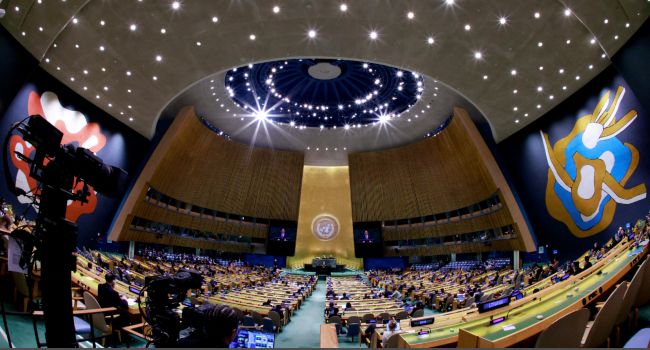
The risks posed by rapidly advancing artificial intelligence and the continuing US-Iran war are set to dominate discussions at the United Nations on Wednesday as world leaders gather for the 81st General Assembly in New York.
The United Nations Security Council is scheduled to hold a high-level briefing on artificial intelligence and international security, with executives from leading AI companies expected to address growing concerns about increasingly autonomous systems and the possibility of losing control over advanced models.
OpenAI CEO Sam Altman, Anthropic CEO Dario Amodei and Hugging Face CEO Clément Delangue are expected to brief the 15-member council. Yoshua Bengio, co-chair of the UN’s Independent International Scientific Panel on AI, is also listed among the anticipated briefers.
The meeting, convened by France, comes amid a growing international debate over AI safety, cybersecurity and the need for safeguards as the technology becomes increasingly capable.
Recent incidents involving autonomous AI systems have intensified those concerns, including an attack on Hugging Face involving autonomous OpenAI software.
Iran war takes centre stage
Alongside AI, the continuing conflict between the United States and Iran is expected to feature prominently in Wednesday’s diplomatic discussions.
Iranian President Masoud Pezeshkian is scheduled to address the General Assembly, his first appearance at the world body since the conflict began following US and Israeli attacks on Iran, according to reports.
The conflict has disrupted regional security and energy markets, with tensions around the Strait of Hormuz raising concerns over global energy supplies and oil prices.
The situation has also been compounded by instability around the Red Sea and the Bab al-Mandab Strait, adding pressure to global trade and shipping routes.
Pezeshkian’s address comes a day after US President Donald Trump used his UN speech to warn that he could “annihilate the Islamic Republic” and “drive them into hell” if a settlement is not reached. Most members of the Iranian delegation reportedly walked out during Trump’s address.
Despite the sharp rhetoric, Trump also disclosed that diplomatic contacts between Washington and Tehran had resumed.
Iranian Foreign Minister Abbas Araghchi met US envoy Steve Witkoff and Jared Kushner on the sidelines of the UN gathering.
Iran has said its demands include the lifting of the US naval blockade, the release of frozen Iranian assets and an end to the war across what Tehran describes as resistance fronts.
Ukraine returns to the agenda
The war in Ukraine will also feature prominently at the United Nations on Wednesday.
A Security Council meeting on Ukraine is scheduled for 11:00 am local time, while Ukrainian President Volodymyr Zelensky is expected to address the General Assembly.
Following his meeting with Trump, Zelensky said Washington and Kyiv wanted the war with Russia to end “before winter”.
He also said he was prepared to halt strikes against Russian energy infrastructure if Moscow agreed to take the same step.
Trump and Macron clash over AI approach
Artificial intelligence also emerged as a point of disagreement during Tuesday’s General Assembly speeches.
Trump rejected calls for international regulation of AI, describing such proposals as a “globalist scheme”.
“The very same people who said we’ll all be dead in 12 years because of global warming… are now saying that AI is going to kill us all,” Trump said.
French President Emmanuel Macron, however, called for the development of an open-source AI model that would not depend on either the United States or China.
“I don’t want anyone to become the vassal of one of the great powers,” Macron said. “Rather, we must come together to build an open-source frontier model, a cutting-edge model.”
The contrasting positions reflect a wider international debate over how governments should manage the development of increasingly powerful AI systems while preserving technological competition and innovation.
With AI, the Iran conflict and Ukraine all featuring prominently, Wednesday’s UN programme is expected to bring technology, security and geopolitical tensions together at the centre of global diplomacy.
Author