
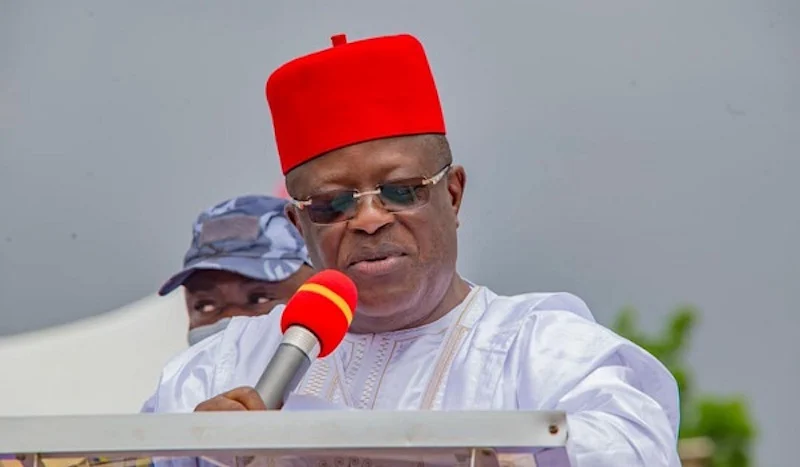
The Minister of Works, Senator David Umahi, has directed contractors handling the ongoing Trans-Sahara Highway project to minimise the demolition of houses and other properties along the road corridor.
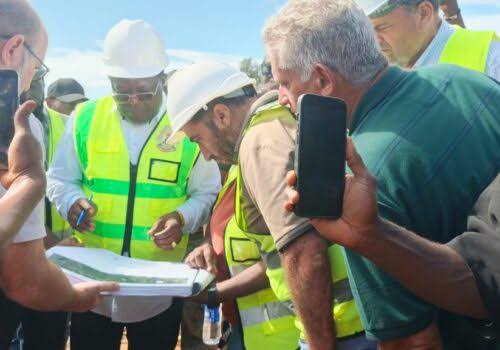
Umahi issued the directive during an inspection of the Federal Government’s Trans-Sahara Highway project, assuring residents and stakeholders that the government would pursue major infrastructure development while protecting communities affected by the construction.
Section One of the Trans-Sahara Highway covers about 123 kilometres from the Ebonyi axis to the Ebonyi-Benue boundary, while Section Two stretches approximately 173.4 kilometres through parts of Benue, Enugu and Kogi states to the Benue River and Nasarawa boundary.
“Section One of the Trans-Sahara Highway covers approximately 123 kilometres from the Ebonyi axis to the Ebonyi-Benue boundary, while Section Two extends about 173.4 kilometres through parts of Benue, Enugu, and Kogi states to the Benue River and Nasarawa boundary,” Umahi said.
With a combined length of roughly 300 kilometres and a design speed of 100 kilometres per hour, Umahi said the completed highway would significantly reduce travel times and improve connectivity across the regions.
“This project will have far-reaching economic implications for the South-East, North-Central, and South-South regions, particularly by strengthening agricultural supply chains, facilitating trade, and expanding commercial activities,” he added.
“Improved road infrastructure along this corridor will also contribute significantly to security by enhancing the mobility of security personnel and connecting previously isolated communities.”
Highway to Boost Regional Connectivity
Umahi said Section One, which is currently being developed as a single carriageway, would eventually have a second carriageway integrated with other legacy infrastructure projects of the Tinubu administration.
He also disclosed plans to dualise an 8.9-kilometre bypass around Afikpo extending towards the Timber Shed area.
The minister expressed satisfaction with the contractor handling Section Two and reaffirmed the Federal Government’s commitment to completing the project despite budget constraints.
“We are prioritising projects in line with available resources, and I can assure you that the Trans-Sahara Highway will be completed by the end of President Tinubu’s second term in office,” he said.
Umahi also defended the administration’s approach to concessioned road projects, saying government officials remained conscious of their legal obligations while responding to public needs.
He urged members of the public and media practitioners to verify information before making comments on complex engineering, contractual and legal issues.
“Where necessary, the Federal Government has intervened outside the original scope of certain contracts to protect citizens’ welfare and improve connectivity,” Umahi said.
The minister appealed to residents along the project corridor to cooperate with enumeration and compensation teams, assuring them that valid claims would be paid.
He also commended host communities in Benue and neighbouring states for maintaining a peaceful environment for construction workers.
Contractors Adjust Road Alignment
The Project Manager for Section Two, Rabih Munayer, said field operations were already being adjusted to reduce avoidable damage to properties along the highway corridor.
“This is Section Two of this major superhighway,” Munayer said, noting that the 173.4-kilometre section remained subject to minor alignment adjustments.
“We are deploying additional pipes and temporary drainage measures during this rainy season to maintain traffic flow and construction activity without causing avoidable damage to structures along the corridor,” he added.
The Lead Consultant and Project Designer for Section Two, Akelakpa Edra, said the project’s engineering designs were also being updated in line with the minister’s directive.
“The revised design takes into account all instructions issued by the Minister, including replacing select culverts with bridges and adjusting alignments where necessary to bypass private properties,” Edra said.
Community leaders along the project corridor expressed optimism following the inspection, describing the Trans-Sahara Highway as a major opportunity for economic and social development across the affected regions.
Author