
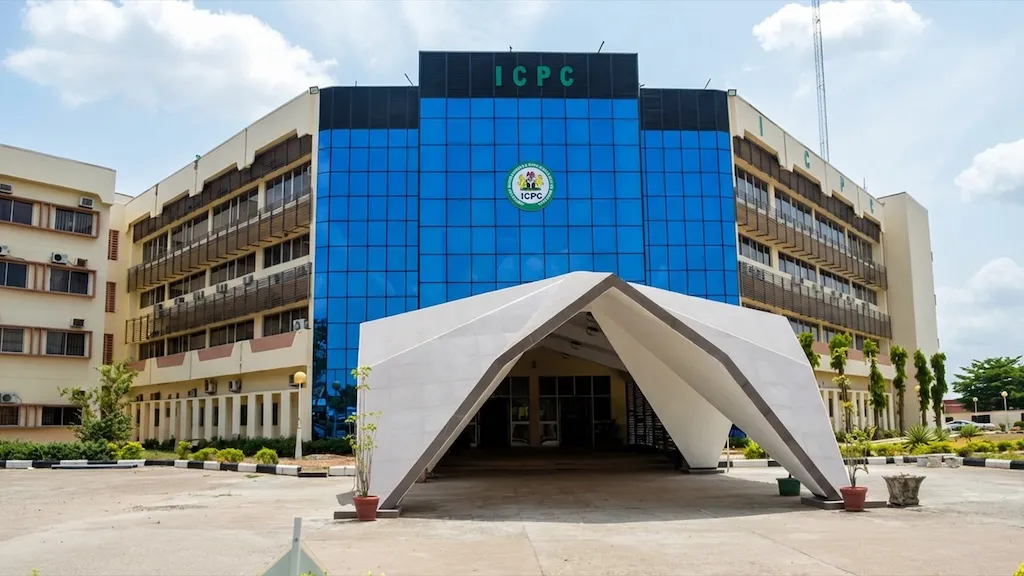
The Independent Corrupt Practices and Other Related Offences Commission (ICPC) has recommended disciplinary action against 13 public officials over their alleged roles in the fake Presidential Foreign Intervention Promotion Council (PFIPC) scandal.
The commission has also recommended the prosecution of Adeniyi Adeyemi, who allegedly presented himself as the Director-General of the PFIPC, for forgery, impersonation, making false statements to public officers and criminal misrepresentation.

The recommendations are contained in an interim ICPC investigation report submitted to President Bola Tinubu on 6 August.
The investigation was launched following Mr Tinubu’s directive to probe how the purported agency, which was not established by any valid law, executive order or other government instrument, gained access to government offices, financial systems and other administrative privileges.
The findings provide further details of how the organisation allegedly penetrated several levels of the federal bureaucracy before the Presidency disowned it.
13 Officials Face Disciplinary Action
The ICPC recommended administrative action against Mimi Abu, director of the Organisation Design and Development Department at the Office of the Head of the Civil Service of the Federation; Rosemary Achem, special adviser on administration to the Director-General of the Budget Office of the Federation; and Patricia Akhigbe, an assistant director at the Ministry of Budget and National Planning.
Others are Aminu Abdullahi, schedule officer, Office Allocation, Office of the Secretary to the Government of the Federation; Bello Abdullahi, assistant director, IPSAS, National Chart of Accounts, Consolidated Account Department, Office of the Accountant-General of the Federation; Sanni Olubunmi, director, Inspectorate Department, OAGF; and Jousha Kadiri Luka, director, Consolidated Accounts Department, OAGF.
The list also includes Muazu Balami, deputy director, Risk and Review, Inspectorate Department, OAGF; Omameh Florence, assistant director, Inspectorate Department, OAGF; Akinlose Moses, Inspectorate Department, OAGF; Ogaba Harry, chief accountant, OAGF; Esther Orji Okoli, principal executive officer I, OAGF; and Ogunbade Habeebat Ajibola, manager, Compliance and Regulation Department, National Information Technology Development Agency.
The commission also recommended that the affected institutions implement reforms identified in its report.
ICPC Seeks Further Investigation
Beyond the disciplinary recommendations, the ICPC called for further investigation into the roles of the Ministry of Foreign Affairs and Ministry of Finance in the process through which legitimacy was allegedly accorded to the PEAC/PFIPC.
It also recommended inviting and questioning officials and individuals connected to the newly uncovered fake ministries, departments and agencies, forged legislative Acts and Unity Bank accounts linked to the organisation.
Those listed for further questioning include the managing director, chief compliance officer and relationship or account officer responsible for the Unity Bank accounts associated with the organisation.
The commission also recommended inviting OAGF officials Adekunle Ajayi and Lovina Akabueze.
It further called for an analysis of all bank accounts linked to Mr Adeyemi and other sources of funds he claimed to have obtained as loans.
The recommendations follow evidence that the purported agency moved through several layers of government without its legal status being independently verified.
The investigation found that the Office of the Secretary to the Government of the Federation, the Office of the Accountant-General of the Federation and the Central Bank of Nigeria acted on requests from the organisation.
In one instance, the OAGF wrote to the CBN on 29 July 2025 requesting four domiciliary accounts for two MDAs, including the PFIPC. The CBN subsequently confirmed the creation of dollar and pound accounts for the purported agency.
Mr Adeyemi also secured access to office space at the Federal Secretariat in Abuja after presenting documents to government authorities. He had approached the OSGF in November 2024 seeking office accommodation and self-accounting status.
How the Fake Agency Gained Access
According to the ICPC, the PFIPC had no valid legal instrument establishing it as a federal government institution.
Despite this, the organisation gained administrative visibility through documents presented as official instruments and was able to access government facilities, interact with public institutions and participate in administrative processes.
The commission said the organisation projected itself as a government entity through representations by its associates and weaknesses in institutional verification procedures.
Government officials who dealt with the organisation generally relied on the documents and information presented to them rather than independently confirming its legal status, according to the report.
The ICPC said the investigation exposed weaknesses in government verification systems and highlighted the need for stronger coordination among agencies.
It recommended stronger mechanisms for authenticating official documents and ensuring that only legally established government entities receive access to public resources, facilities, financial systems and administrative privileges.
Presidency Disowns PFIPC
The Presidency has maintained that neither the PFIPC nor Mr Adeyemi’s purported appointment existed under President Bola Tinubu’s administration.
The President’s Chief of Staff, Femi Gbajabiamila, previously described the PFIPC as fake and said Mr Adeyemi was never appointed to head such an agency.
The ICPC investigation cleared Mr Gbajabiamila of any wrongdoing.
The investigation has also resulted in criminal proceedings against Mr Adeyemi. Police charged him and two other defendants with eight counts involving conspiracy, forgery and impersonation.
Mr Adeyemi was arrested in July after a Federal High Court in Abuja issued a warrant for his arrest when he failed to appear for a scheduled arraignment.
He has denied wrongdoing and is expected to defend himself in court.
The ICPC said its findings and recommendations were submitted for consideration and appropriate action under applicable laws, regulations and public service procedures, while investigations continue into areas requiring further scrutiny.
Investigators Uncover Another Fake Agency
The PFIPC investigation also led to the discovery of another suspected fake agency, the National Brands Development and Made in Nigeria Special Project Office, which allegedly operated within the Office of the Secretary to the Government of the Federation.
President Tinubu ordered the suspension of three permanent secretaries and the arrest of the alleged promoter of the agency, George Buchi Nwabueze.
ICPC Chairman Musa Aliyu said investigators found that Mr Nwabueze operated under several variations of his name and that there were suspected collaborators within the OSGF.
The commission said forged legislative instruments were allegedly used to give the entities an appearance of legitimacy and facilitate the opening of bank accounts in their names.
The discovery has widened the scandal beyond the PFIPC and raised further questions about weaknesses in the government’s verification and oversight systems that allow individuals and organisations to present themselves as legitimate government entities.
Author