
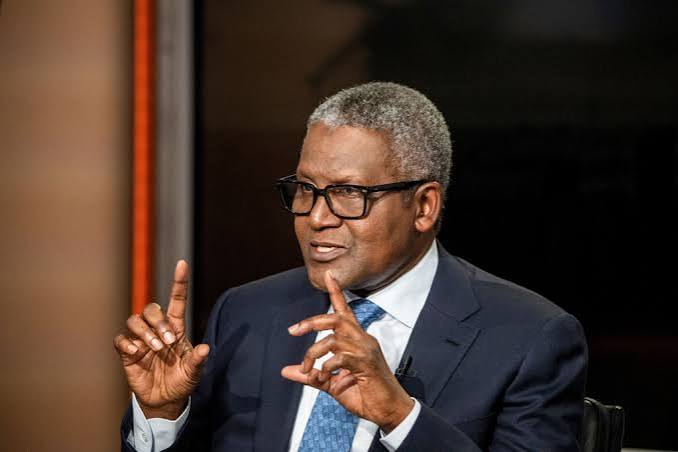
Aliko Dangote, President of Dangote Industries Limited, has warned that Nigeria may not see another new refinery built over the next decade unless the government adopts policies that provide stronger protection and certainty for domestic industrial investors.
Speaking in an interview with ARISE News, Dangote said the country’s difficult investment environment, including high borrowing costs and what he described as inadequate policy protection, could discourage entrepreneurs from committing capital to large-scale industrial projects.
He identified interest rates as a major obstacle to industrialisation, saying it was “very difficult to industrialise with interest rates at 30%.”
However, Dangote said the larger concern for potential refinery investors was the absence of policies capable of protecting domestic production against competing imports.
“Under the current things that are going on, especially in the downstream, I cannot see any new refinery in our lifetime,” Dangote said.
He challenged Nigerians to assess his prediction in 10 years.
“Mark me and write it on board,” he said. “I’m telling you today is 13th of September, 2026. I want me and you to review another September — I mean, 13th of September, year 2036. By God’s grace, if we’re all alive, by God’s grace, there will not be any refinery.”
Asked why he was so confident, Dangote said there was little incentive for investors to undertake such projects under the current conditions.
“Because there is nothing to encourage anybody to do that.”
He argued that the challenge went beyond financing costs, stressing that investors needed assurances that domestic industries would be adequately protected.
“Not the interest rate, because the policy is not there to protect,” he said.
According to Dangote, governments seeking to create jobs, expand economic activity and increase tax revenues must also provide policies that support domestic production.
“If a government wants to create jobs, they want to create economic activities, they want to collect tax, they also have to give something in. And the only thing that they will give in is to protect the domestic industry.”
He also warned that excessive dependence on imports could undermine employment and domestic productive capacity.
“If you import, what you are doing is that you are importing poverty and exporting jobs that you’re supposed to create out of the country,” he said.
Dangote pointed to India, Singapore and South Korea as examples of countries that developed significant refining and industrial capacity despite having limited or no crude oil resources.
He argued that Africa has entrepreneurs with the capacity to undertake similarly ambitious investments but said many are unwilling to expose their capital to what he considers an uncertain business environment.
Asked whether the continent has enough entrepreneurs capable of driving large-scale industrialisation, Dangote responded:
“They have, they have. But these entrepreneurs, most of these entrepreneurs, they are actually scared to death.”
On why wealthy Nigerians with significant liquidity could not be persuaded to make similar investments, Dangote said the willingness to repeatedly confront the challenges associated with major industrial projects was not universal.
“I’m trying my best, but everybody is not Aliko, who wants to fight every day.”
He added:
“I fight every day, morning, day and night. It has become part of me now. I enjoy fighting.”
The comments come as Dangote Petroleum Refinery continues efforts to expand its refining capacity, underscoring Dangote’s broader argument that Nigeria needs an investment environment capable of encouraging more domestic industrial projects.
For Dangote, attracting another generation of large-scale refineries and manufacturing investments will require more than lower financing costs. He believes investors also need predictable policies and stronger protection for domestic production to have confidence that major projects will remain commercially viable over the long term.
Author