
Iran Retaliates Against US Positions as Revolutionary Guards Warn of Broader Response to Ceasefire Violations
WASHINGTON / TEHRAN / MANAMA — The fragile memorandum of understanding that brought an end to weeks of devastating hostilities between the United States and Iran is now under severe and possibly terminal strain, after both nations traded accusations of ceasefire violations, and, critically, traded actual military strikes, within the space of a single extraordinary day. What began as a dispute over a commercial vessel in the Strait of Hormuz has escalated into the most dangerous rupture in the US-Iran truce since it was signed, threatening to unravel not only the ceasefire but a broader web of regional diplomatic progress that includes a landmark Israeli-Lebanese framework agreement brokered in Washington.
The Spark: A Commercial Ship, a Disputed Attack, and Competing Narratives
The sequence of events that plunged the ceasefire into crisis began earlier in the week, when American forces accused Iran of attacking a commercial cargo vessel transiting the Strait of Hormuz, the narrow waterway through which approximately one-fifth of the world’s oil and gas exports flow. Tehran did not acknowledge the incident, offering neither confirmation nor a direct rebuttal of the allegation. In the absence of Iranian accountability, Washington drew its own conclusions.
The US Central Command moved quickly. It announced that its forces had conducted targeted military operations against Iranian missile and drone storage facilities as well as coastal surveillance and radar installations, the very infrastructure that Tehran depends on to monitor and, when it chooses, to interdict maritime traffic in the Gulf. CENTCOM framed the operation not as aggression but as a proportional and necessary response to what it characterised as “unwarranted aggression against commercial shipping by Iranian forces” that “clearly violated the ceasefire.”
President Donald Trump, true to the blunt register that has defined his communications throughout the conflict, weighed in directly. “This is a foolish violation of our ceasefire agreement,” he said, referring to what he described as an Iranian drone strike on the commercial vessel. His vice president, JD Vance, followed with a warning posted on X that left little room for diplomatic ambiguity: “Violence will be met with violence” if Iran launched further attacks.
“This is a foolish violation of our ceasefire agreement. — US President Donald Trump”
Tehran’s Counter-Narrative: ‘A Blatant Violation by Washington’
Iran’s response was swift, furious, and delivered through multiple channels simultaneously. The Iranian Foreign Ministry released a formal statement characterising the American military strikes on its coastal surveillance facilities as “brutal attacks” and a “blatant violation” of the memorandum of understanding that ended the war. In Tehran’s reading of events, it was not Iran that had broken the ceasefire, it was the United States. The allegation about the commercial vessel, the ministry implied, was pretext.
The Islamic Revolutionary Guard Corps moved from rhetoric to action. It announced retaliatory strikes against American military positions in the Gulf region, describing the operation in measured but unambiguous terms. “If the aggression is repeated, our response will be broader than this,” the Guards warned in a statement carried by Iranian state television on Telegram, a public declaration that Tehran was prepared to escalate further if Washington did not stand down.
“These brutal attacks, which targeted Iranian coastal surveillance facilities, are a blatant violation of the memorandum of understanding that ended the war. — Iranian Foreign Ministry”
The competing narratives exposed a fundamental problem at the heart of the ceasefire architecture: neither side had agreed on what, precisely, constituted a violation. The memorandum of understanding that ended the conflict had apparently left enough ambiguity in its terms, or enough room for self-interested interpretation, that both Washington and Tehran could, in good faith or otherwise, accuse the other of firing the first prohibited shot. In such a climate, the agreement functions less as a binding constraint and more as a political instrument to be wielded whenever it serves the accuser’s interests.
The Conflict Spreads: Iranian Drones Over Bahrain
The military exchanges did not remain contained to a US-Iran bilateral confrontation. The Kingdom of Bahrain, host to the United States Naval Forces Central Command and one of Washington’s most critical Gulf partners, was drawn into the crisis when its Foreign Ministry announced that several Iranian drones had targeted Bahraini territory. The strikes were condemned by Manama in the strongest terms, with Bahraini officials accusing Tehran of “sabotaging peace efforts” at precisely the moment when the region appeared to be pulling back from the brink.
The attack on Bahrain added a new and complicating dimension to the crisis. It signalled that Iran was not limiting its retaliatory action to direct US military assets, it was prepared to strike at American partners and regional architecture more broadly. Whether the Bahrain strikes were ordered centrally by Tehran or represented a decision by a more autonomous element within the Revolutionary Guards apparatus remained unclear, but the effect was the same: the geography of the conflict had expanded.
The Strait of Hormuz: Commerce, Oil Markets, and the Limits of Iranian Leverage
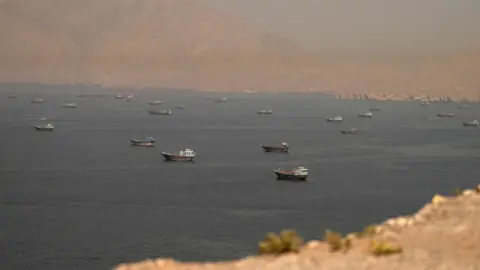
Even as missiles and drones flew, commercial shipping continued to move through the Strait of Hormuz, though not without complications. Iran had issued warnings to vessels against entering or leaving the Gulf without its prior authorisation, a directive that some ships appeared to be defying by using alternative routes outside Tehran’s approved corridors. The spectacle of tankers navigating a geopolitical minefield while Iran and the United States exchanged fire illustrated the extraordinary importance of the strait and the high stakes attached to its control.
Oil markets, meanwhile, offered a paradoxical signal. Prices fell, rather than spiked, as traders appeared to bet that the Strait of Hormuz would remain open despite the hostilities, a reading of the situation grounded in both the economic interests of all parties and the historical resilience of Gulf energy infrastructure. The relative calm in commodities markets was not a verdict on the diplomatic situation; it was a market judgment about operational reality. But it also served to reduce one of the key pressure levers that might otherwise accelerate a negotiated de-escalation.
“Violence will be met with violence. — US Vice President JD Vance”
Israel and Lebanon Sign Framework Agreement in Washington
Against the backdrop of the Iran-US confrontation, a separate and significant diplomatic development unfolded in Washington. Israel and Lebanon signed a US-brokered framework agreement intended to advance peace along their shared border, a development that, in any other week, would have dominated international headlines. The agreement was the product of five rounds of negotiations conducted in Washington and represented one of the most substantive moves toward Israeli-Lebanese normalisation in decades.
Under the terms of the framework, Lebanese armed forces would gradually assume control of two pilot areas currently occupied by Israeli troops, while a process for disarming the Iran-backed Hezbollah movement would be put in motion. Israeli Prime Minister Benjamin Netanyahu, speaking at the signing ceremony, characterised the agreement as a strategic victory over Iran, framing it as evidence that Tehran’s regional influence could be rolled back through sustained pressure and diplomatic engagement.
US Secretary of State Marco Rubio described the trilateral accord as a document that “begins to put in place a framework for lasting peace and security” deliberately hedged language that acknowledged the considerable distance remaining between a framework and a final resolution. Lebanese President Joseph Aoun was similarly measured, calling the agreement a “first step” toward enabling displaced residents to return home under Lebanese state sovereignty. Notably, Netanyahu confirmed that displaced civilians would not be permitted to return to contested areas immediately, a detail that is likely to remain a political fault line.
Hezbollah’s Supporters Protest; Iran’s Regional Architecture Under Pressure
Not everyone in the region welcomed the Israeli-Lebanese accord. Supporters of Hezbollah staged protests in Beirut on Friday night, arguing that the framework agreement undermined a broader regional settlement linked to the ongoing US-Iran negotiations. The protests reflected a calculation widely held in Hezbollah-aligned circles: that agreeing to a Lebanese framework with Israel in isolation, without a parallel resolution of the Iran-US conflict, effectively separated Lebanon from the wider axis of resistance and left Tehran more isolated.
That calculation is not without logic. The Israeli-Lebanese framework and the Iran-US ceasefire collapse are not independent events, they are connected nodes in a single regional architecture. A Lebanon that moves toward disarming Hezbollah and normalising with Israel fundamentally alters the strategic geometry that Iran has spent decades constructing. If the US-Iran ceasefire unravels at the same time, Tehran faces the prospect of regional isolation without the leverage that a functioning truce would provide in negotiations.
What Comes Next: Talks Continue, But the Architecture Is Cracking
Despite the military exchanges and the mutual accusations of ceasefire violation, both sides have publicly stated that negotiations toward a broader, permanent settlement continue. That diplomatic channel, tenuous, contested, and operating in parallel with active military operations, is now the only structural barrier between the current crisis and a full return to open conflict.
The critical question is whether the memorandum of understanding can survive the weight being placed upon it. Both Washington and Tehran have now used it as a political instrument, accusing the other of violation while justifying their own strikes as legitimate responses to prior breaches. Once a ceasefire becomes a document that both sides claim the other has already broken, its deterrent value collapses. What remains is not a peace agreement but a pause, and pauses, as this region has demonstrated repeatedly, do not hold indefinitely without political will to sustain them.
The coming days will test whether the back-channel negotiations still functioning between American and Iranian envoys carry enough weight to pull both governments back from the edge. The Israeli-Lebanese framework, fragile as it is, offers a model of what careful, sustained diplomacy can produce. Whether that model can be applied to the harder, higher-stakes question of US-Iran relations, while drones continue to fly over the Gulf, remains the defining uncertainty of this moment.
Author