

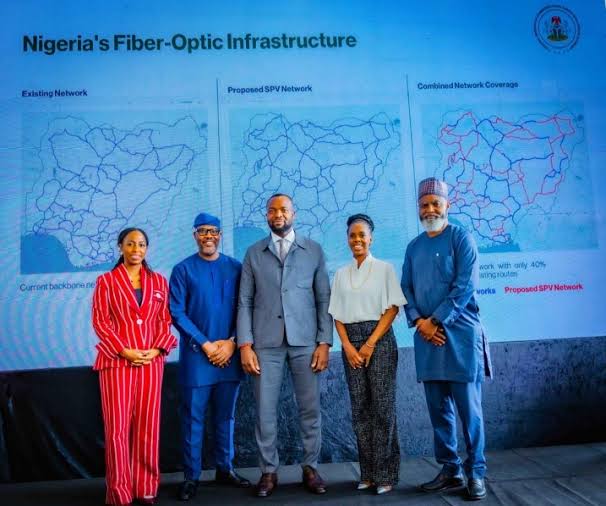
The Federal Government is seeking about $1.2 billion in private capital to finance the remaining portion of its planned 90,000-kilometre nationwide fibre network, with physical deployment expected to begin in October.
The project, known as Project BRIDGE, is being structured as a public-private partnership, with a newly incorporated special-purpose vehicle, Bridge Open Access (Bridge OA), established to drive its implementation.
The estimated cost of the network is $2 billion, of which $800 million has already been covered through sovereign financing commitments.
The secured financing comprises a $500 million World Bank facility approved in October 2025, a $200 million African Development Bank loan approved in April 2026 and a $100 million loan from the European Bank for Reconstruction and Development approved in February 2026. The European Union has also provided a €22 million grant for the project.
The Federal Government said the outstanding $1.2 billion is not a condition that must be met before construction can commence. Rather, it represents the remaining portion of the project’s estimated capital requirement and is expected to be mobilised through the private-sector structure.
Strategic Communications Adviser to the Minister of Communications, Innovation and Digital Economy, Osibo Imhoitsike, said the project had attracted significant interest from private investors, with the process of finalising a private-sector investment offer ongoing.
“The government has received a significant private sector investment offer as part of the PPP structure, and that process is currently being concluded,” Imhoitsike said.
Minister of Communications, Innovation and Digital Economy Bosun Tijani confirmed in August that physical rollout was expected to begin in October, following the incorporation of Bridge OA in August.
The special-purpose vehicle will be responsible for financing and constructing the network and subsequently operating it as a wholesale open-access infrastructure company.
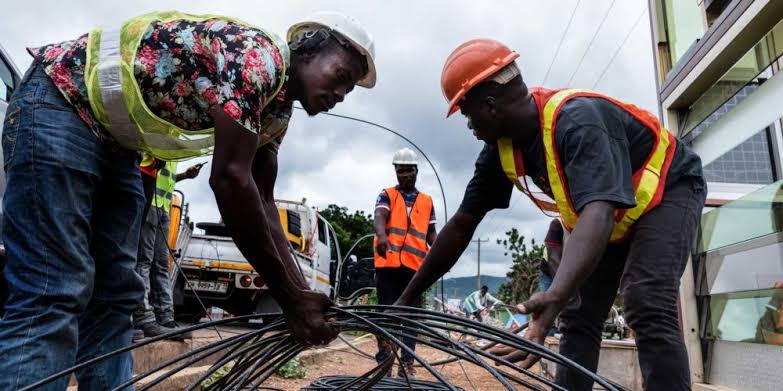
Rather than providing retail internet services directly to consumers, Bridge OA is expected to sell fibre capacity to qualified operators on equal and non-discriminatory terms. Potential users of the infrastructure include telecommunications companies, internet service providers, banks and cloud providers.
Under the proposed ownership structure, private investors are expected to hold between 51 per cent and 75 per cent of Bridge OA, alongside operational control. The Federal Government, through the Ministry of Finance Incorporated, is expected to retain between 25 per cent and 49 per cent.
The structure is intended to combine private capital and operating expertise with government financing while giving the private sector majority ownership of the infrastructure company.
The planned network is expected to significantly expand Nigeria’s fibre infrastructure. The project is designed to increase the national fibre network from about 35,000 kilometres to roughly 125,000 kilometres.
The World Bank said the programme would support efforts to close Nigeria’s digital divide by expanding access to affordable, high-speed broadband in underserved and unserved communities.
“The BRIDGE project puts into action the bold and ambitious vision to unlock the potential of the digital economy in Nigeria, working alongside the private sector,” World Bank Country Director for Nigeria, Mathew Verghis, said.
The government expects improved fibre access to support economic activity and digital services across the country.
According to the project’s stated objectives, reliable high-speed internet could contribute to job creation across all 774 local government areas while improving access to services such as education and healthcare.
The project’s implementation timeline has undergone several revisions. It was previously targeted for the fourth quarter of 2025 or the first quarter of 2026, but large-scale construction was deferred as the government worked on establishing the special-purpose vehicle, securing private investors and completing procurement and implementation arrangements.
The project was initially expected to take about five years, with approximately 30,000 kilometres targeted for the first year. Tijani has since revised the overall delivery period to three years, bringing forward the expected completion of the 90,000-kilometre network.
The Federal Government formally opened consultations with potential private-sector investors in March 2025, inviting expressions of interest in the special-purpose vehicle under the PPP structure.
With the incorporation of Bridge OA and the expected October rollout, the project is now moving from financing and institutional structuring towards physical implementation.
Follow us on:
Author