
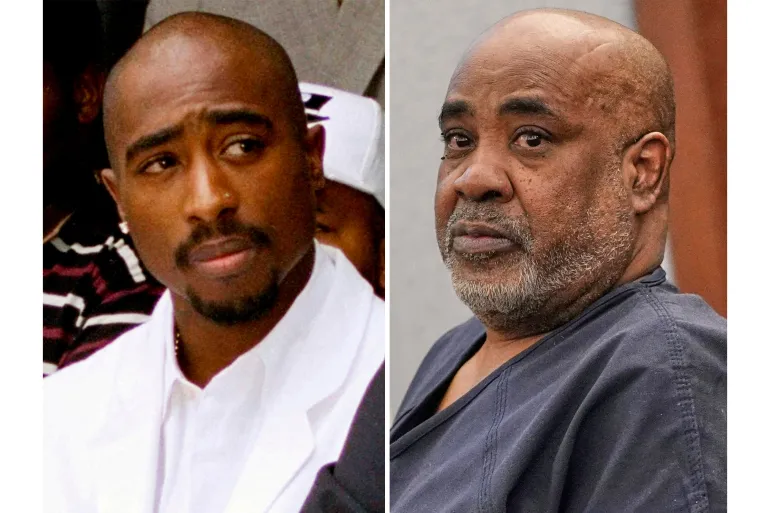
Opening arguments are expected Monday in the trial of a former gang leader accused of orchestrating the 1996 murder of rap icon Tupac Shakur, three decades after the killing shocked the music world.
Duane “Keffe D” Davis, 63, is accused of ordering the killing and providing the gun used in the drive-by shooting that claimed Shakur’s life in Las Vegas.
Davis, a former leader of the South Side Compton Crips, was in court last week as jurors were selected. If convicted, he faces life in prison without the possibility of parole.
The trial could last more than a month, although it may not establish who actually fired the shots that killed Shakur on September 7, 1996.
The rapper was 25 when he was shot after attending a Mike Tyson boxing match at the MGM Grand casino.
Gang Rivalry At Centre Of Case
The prosecution is expected to argue that the killing was driven by a long-running rivalry between rival Los Angeles gangs and the wider feud between the East Coast and West Coast hip-hop scenes.
Shakur, widely known as 2Pac, was one of the defining figures of the era and had become closely associated with California after signing with Los Angeles-based Death Row Records.
The son of a Black Panther, Shakur was raised in Harlem and Baltimore before becoming one of the most prominent figures in West Coast rap.
His best-known songs include “California Love” and “All Eyez on Me”.
The case also revisits the rivalry between Death Row Records, founded by Marion “Suge” Knight, and Bad Boy Records, the New York-based label founded by Sean “Diddy” Combs.
Bad Boy signed Christopher “The Notorious B.I.G.” Wallace, who was killed in Los Angeles in March 1997, six months after Shakur’s death.
Prosecutors say Death Row Records had ties to Mob Piru, a Los Angeles gang associated with the Bloods alliance, while Bad Boy Records had hired members of the South Side Compton Crips as security.
Fight Before Fatal Shooting
The prosecution says tensions escalated after the Tyson fight when Knight and Shakur confronted and assaulted Davis’s nephew, Orlando “Baby Lane” Anderson, who was a member of the Crips.
The confrontation was reportedly retaliation for an alleged assault involving a Death Row employee.
Prosecutors allege that Davis subsequently sought revenge.
Later that night, a white Cadillac carrying Davis, Anderson and others pulled alongside Shakur’s vehicle in Las Vegas.
Gunmen opened fire from the Cadillac, fatally wounding Shakur.
Case Revived After Davis Memoir
The investigation remained unresolved for decades as authorities struggled to gather enough evidence to make an arrest.
The case was revived after Davis published a memoir in 2019 in which he described his involvement that night.
Davis wrote that he was sitting in the front passenger seat of the Cadillac and had handed a pistol to people in the back seat.
However, he did not identify the person who fired the shots.
The other people who were in the Cadillac that night have since died.
Davis has subsequently sought to distance himself from the account, saying his statements were exaggerated and that a ghostwriter created parts of the book to boost sales.
He has pleaded not guilty to the charge.
The trial is expected to revisit one of the most enduring mysteries in American music and could provide the most significant examination yet of the events surrounding Shakur’s death.
Author