
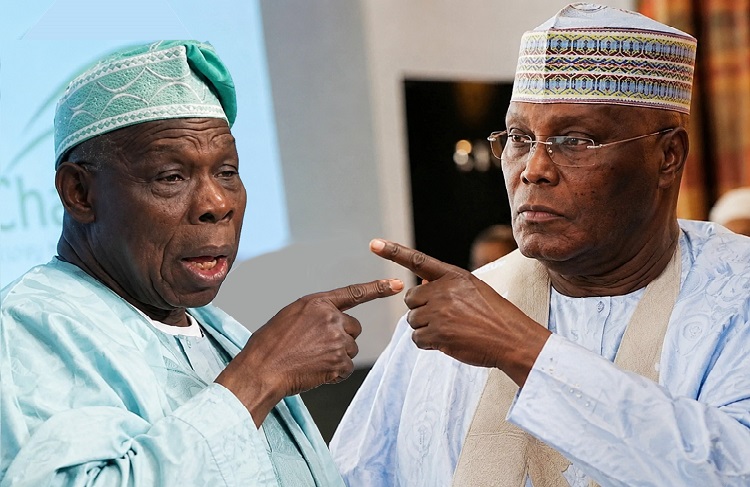
Former Vice President Atiku Abubakar has rejected allegations that he paid the late former Speaker of the House of Representatives, Ghali Na’Abba, N5 million to begin impeachment proceedings against former President Olusegun Obasanjo.
In a statement issued on Friday by his Senior Special Assistant on Public Communication, Phrank Shaibu, Atiku described the allegation as baseless and questioned why it surfaced only after Na’Abba’s death.
Obasanjo had alleged in a letter released on Thursday that Atiku paid the former Speaker N5 million to initiate impeachment proceedings during his first term in office. He also claimed the former vice president sought to persuade Na’Abba to pressure him into serving only one presidential term.
Responding to the claims, Atiku said the timing of the allegation raises questions, arguing that the late Na’Abba is no longer alive to confirm or deny the accusation.
“If this allegation were true, why did he never make it while Rt. Hon. Na’Abba was alive? Why wait until the only man who could confirm or refute the claim has departed this world?” the statement read.
Atiku added that invoking a deceased public figure in such a serious allegation deprives Nigerians of hearing both sides of the story.
“The late Rt. Hon. Ghali Na’Abba cannot now defend his own integrity or respond to the allegation that he accepted a bribe. It is unfair to his memory and contrary to our cultural values to conscript the dead into contemporary political battles when they no longer have a voice,” the statement added.
The former vice president challenged Obasanjo to provide evidence supporting the allegation, asking why no action was taken at the time if any wrongdoing had occurred.
“If there was indeed evidence of any criminal conduct as alleged, Nigerians are entitled to ask why no action was taken at the time by a government that wielded the full powers of the Nigerian state,” he said.
Atiku also suggested the allegation was politically motivated as discussions ahead of the 2027 general election intensify.
He argued that the claim was intended to damage his reputation and influence public opinion in favour of Obasanjo’s preferred candidate.
The former vice president maintained that his political disagreements with Obasanjo stemmed from his opposition to the former president’s alleged third-term agenda, which he said violated constitutional principles.
“My offence was that I stood firmly against the unconstitutional third-term agenda. As a democrat, I chose the path of constitutionalism and the rule of law,” Atiku stated.
He said Nigeria’s leaders should focus on addressing rising food prices, increasing public debt and security challenges rather than revisiting political disputes from more than two decades ago.
Atiku urged Obasanjo to openly support his preferred candidate for the 2027 presidential election instead of making allegations that cannot be independently verified.
The dispute traces back to tensions between the executive and legislature during Obasanjo’s first term. In 2002, the House of Representatives under Speaker Ghali Na’Abba initiated impeachment proceedings against the president over alleged constitutional breaches, including budget implementation and military operations without legislative approval.
Although the Senate backed the move, intervention by former Heads of State Shehu Shagari and Yakubu Gowon halted the impeachment process.
Na’Abba later said in a 2018 interview that he regretted the impeachment did not proceed. He died in Abuja on December 27, 2023, at the age of 65.
Author