
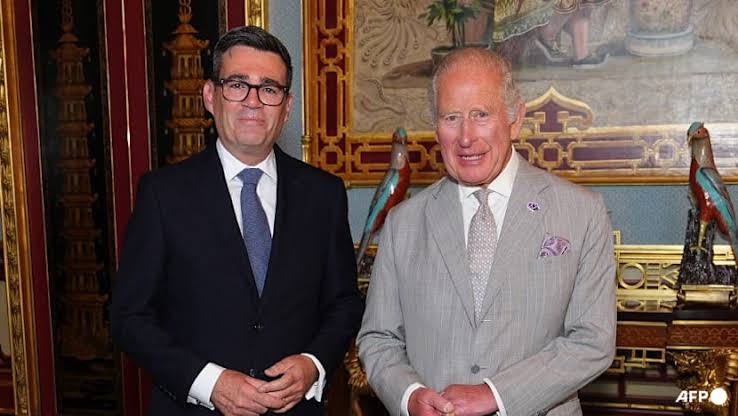
Andy Burnham has officially become the United Kingdom’s new prime minister after meeting King Charles III at Buckingham Palace and accepting the monarch’s invitation to form a new government.
Burnham succeeds Keir Starmer, who formally resigned after delivering a farewell speech outside 10 Downing Street on Monday, ending his two-year tenure.
The 56-year-old becomes Britain’s sixth prime minister in the past decade.
Before leaving office, Starmer defended his record, saying his government had strengthened the country.
“I am confident that Britain is now stronger and fairer than it was two years ago.”
“I go with good grace, I go with a smile, and I go proud of everything that we have achieved.”
Following Starmer’s resignation, King Charles accepted the outgoing prime minister’s departure before inviting Burnham to form the next government, in line with constitutional tradition.
Burnham is expected to outline his administration’s priorities in his first address as prime minister, focusing on restoring public confidence in government, tackling the cost-of-living crisis and driving economic growth.
His team said the new administration will also prioritise greater devolution of powers to regional communities.
Later on Monday, Burnham is expected to announce his first Cabinet, with particular attention on who will replace Rachel Reeves as Chancellor.
The former Mayor of Greater Manchester was selected by the Labour Party after Starmer stepped down last month, with party lawmakers viewing him as the strongest candidate to counter the growing popularity of Nigel Farage’s Reform UK.
Speaking ahead of assuming office, Burnham said Britain needed a new direction after years of political instability.
“What we’ve been doing hasn’t been working. That’s the way I see it.”
“I am going to try and do things in a different way.”
Among his immediate challenges are sluggish economic growth, rising government borrowing costs, growing welfare spending and continued pressure over irregular migration.
Global uncertainties, including volatile energy prices linked to the US-Iran conflict and changing international economic conditions, are also expected to test the new administration.
Burnham has pledged to prioritise early investment, economic reform and measures to ease the financial pressures facing households.
His first major policy move came before taking office, when he announced the cancellation of the previous government’s proposed nationwide digital identity scheme, with the funds to be redirected towards cost-of-living support.
Burnham previously served as a Member of Parliament from 2001 to 2017 and held ministerial positions under former Prime Ministers Tony Blair and Gordon Brown before becoming Mayor of Greater Manchester.
With the next general election expected in 2029, Burnham now faces the challenge of rebuilding public confidence while steering Labour through a demanding political and economic landscape.
Author